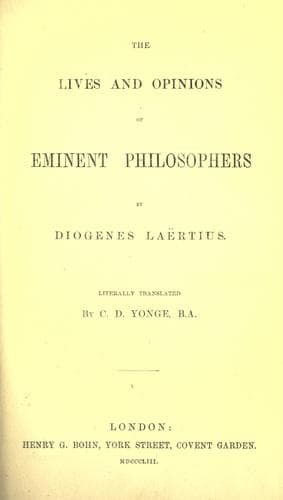
The Lives and Opinions of Eminent PhilosophersDiogenes Laertius
Philosophy
The Lives and Opinions of Eminent Philosophers
Diogenes Laertius
Philosophers, Ancient -- Biography; Philosophy, Ancient
He once asked for a statue; and being questioned as to his reason for
doing so, he said, “I am practising disappointment.” Once he was begging
of some one (for he did this at first out of actual want), he said, “If
you have given to any one else, give also to me; and if you have never
given to any one, then begin with me.” On one occasion, he was asked
by the tyrant, “What sort of brass was the best for a statue?” and he
replied, “That of which the statues of Harmodius and Aristogiton are
made.” When he was asked how Dionysius treats his friends, he said,
“Like bags; those which are full he hangs up, and those which are empty
he throws away.” A man who was lately married put an inscription on his
house, “Hercules Callinicus, the son of Jupiter, lives here; let no evil
enter.” And so Diogenes wrote in addition, “An alliance is made after the
war is over.” He used to say that covetousness was the metropolis of all
evils. Seeing on one occasion a profligate man in an inn eating olives,
he said, “If you had dined thus, you would not have supped thus.” One of
his apophthegms was, that good men were the images of the Gods; another,
that love was the business of those who had nothing to do. When he was
asked what was miserable in life, he answered, “An indigent old man.” And
when the question was put to him, what beast inflicts the worst bite, he
said, “Of wild beasts the sycophant, and of tame animals the flatterer.”
On one occasion he saw two Centaurs very badly painted; he said, “Which
of the two is the worst?”[62] He used to say that a speech, the object of
which was solely to please, was a honeyed halter. He called the belly,
the Charybdis of life. Having heard once that Didymon the adulterer,
had been caught in the fact, he said, “He deserves to be hung by his
name.”[63] When the question was put to him, why gold is of a pale
colour, he said, “Because it has so many people plotting against it.”
When he saw a woman in a litter, he said, “The cage is not suited to the
animal.” And seeing a runaway slave sitting on a well, he said, “My boy,
take care you do not fall in.” Another time, he saw a little boy who
was a stealer of clothes from the baths, and said, “Are you going for
unguents, (ἐπ’ ἀλειμμάτιον), or for other garments (ἐπ’ ἄλλ’ ἱμάτιον).”
Seeing some women hanging on olive trees, he said, “I wish every tree
bore similar fruit.” At another time, he saw a clothes stealer, and
addressed him thus:—
“What moves thee, say, when sleep has clos’d the sight,
To roam the silent fields in dead of night?
Art thou some wretch by hopes of plunder led,
Through heaps of carnage to despoil the dead.”[64]
When he was asked whether he had any girl or boy to wait on him, he said,
“No.” And as his questioner asked further, “If then you die, who will
bury you?” He replied, “Whoever wants my house.” Seeing a handsome youth
sleeping without any protection, he nudged him, and said, “Wake up:—
Public-domain text, read in full here on John Shaqi.
Reviews
Reviews
No reviews yet
Be the first to share your thoughts on this work.
Elsewhere in the archive
Join the Discussion
Join the discussion
Sign in to leave a comment or review.
Sign InorCreate an account