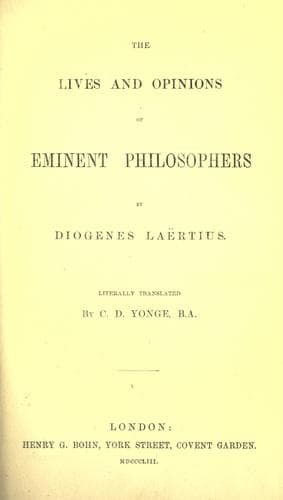
The Lives and Opinions of Eminent PhilosophersDiogenes Laertius
Philosophy
The Lives and Opinions of Eminent Philosophers
Diogenes Laertius
Philosophers, Ancient -- Biography; Philosophy, Ancient
This used to be the language which he held, and he used to show in
practice, really altering men’s habits, and deferring in all things
rather to the principles of nature than to those of law; saying that he
was adopting the same fashion of life as Hercules had, preferring nothing
in the world to liberty; and saying that everything belonged to the wise,
and advancing arguments such as I mentioned just above. For instance:
every thing belongs to the Gods; and the Gods are friends to the wise;
and all the property of friends is held in common; therefore everything
belongs to the wise. He also argued about the law, that without it there
is no possibility of a constitution being maintained; for without a
city there can be nothing orderly, but a city is an orderly thing; and
without a city there can be no law; therefore law is order. And he played
in the same manner with the topics of noble birth, and reputation, and
all things of that kind, saying that they were all veils, as it were,
for wickedness; and that that was the only proper constitution which
consisted in order. Another of his doctrines was that all women ought
to be possessed in common; and he said that marriage was a nullity, and
that the proper way would be for every man to live with her whom he
could persuade to agree with him. And on the same principle he said,
that all people’s sons ought to belong to every one in common; and there
was nothing intolerable in the idea of taking anything out of a temple,
or eating any animal whatever, and that there was no impiety in tasting
even human flesh; as is plain from the habits of foreign nations; and he
said that this principle might be correctly extended to every case and
every people. For he said that in reality everything was a combination
of all things. For that in bread there was meat, and in vegetables there
was bread, and so there were some particles of all other bodies in
everything, communicating by invisible passages and evaporating.
VII. And he explains this theory of his clearly in the Thyestes, if
indeed the tragedies attributed to him are really his composition, and
not rather the work of Philiscus, of Ægina, his intimate friend, or
of Pasiphon, the son of Lucian, who is stated by Phavorinus, in his
Universal History, to have written them after Diogenes’ death.
VIII. Music and geometry, and astronomy, and all things of that kind, he
neglected, as useless and unnecessary. But he was a man very happy in
meeting arguments, as is plain from what we have already said.
Public-domain text, read in full here on John Shaqi.
Reviews
Reviews
No reviews yet
Be the first to share your thoughts on this work.
Elsewhere in the archive
Join the Discussion
Join the discussion
Sign in to leave a comment or review.
Sign InorCreate an account