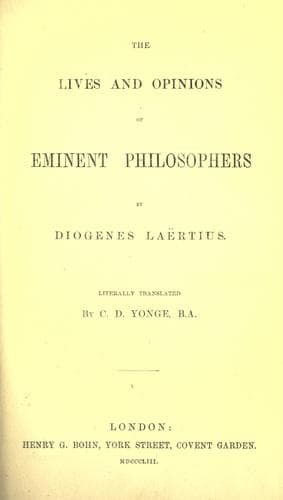
The Lives and Opinions of Eminent PhilosophersDiogenes Laertius
Philosophy
The Lives and Opinions of Eminent Philosophers
Diogenes Laertius
Philosophers, Ancient -- Biography; Philosophy, Ancient
But Sosicrates, in the first book of his Successions, and Satyrus, in
the fourth book of his Lives, both assert that none of all these are the
genuine composition of Diogenes. And Satyrus affirms that the tragedies
are the work of Philiscus, the Æginetan, a friend of Diogenes. But
Sotion, in his seventh book, says that these are the only genuine works
of Diogenes: a dialogue on Virtue; another on the Good; another on Love;
the Beggar; the Tolmæus; the Leopard; the Cassander; the Cephalion;
and that the Aristarchus, the Sisyphus, the Ganymede, a volume of
Apophthegms, and another of Letters, are all the work of Philiscus.
XIII. There were five persons of the name of Diogenes. The first a native
of Apollonia, a natural philosopher; and the beginning of his treatise
on Natural Philosophy is as follows: “It appears to me to be well for
every one who commences any kind of philosophical treatise, to lay down
some undeniable principle to start with.” The second was a Sicyonian, who
wrote an account of Peloponnesus. The third was the man of whom we have
been speaking. The fourth was a Stoic, a native of Seleucia, but usually
called a Babylonian, from the proximity of Seleucia to Babylon. The
fifth was a native of Tarsus, who wrote on the subject of some questions
concerning poetry which he endeavours to solve.
XIV. Athenodorus, in the eighth book of his Conversations, says, that the
philosopher always had a shining appearance, from his habit of anointing
himself.
LIFE OF MONIMUS.
I. Monimus was a Syracusan, and a pupil of Diogenes, but also a slave
of some Corinthian money-changer, as Sosicrates tells us. Xeniades, who
bought Diogenes, used often to come to him, extolling the excellency of
Diogenes both in actions and words, till he excited a great affection
for the man in the mind of Monimus. For he immediately feigned madness,
and threw about all the money and all the coins that were on the table,
until his master discarded him, and then he straightway went to Diogenes
and became his pupil. He also followed Crates the Cynic a good deal, and
devoted himself to the same studies as he did; and the sight of this
conduct of his made his master all the more think him mad.
II. And he was a very eminent man, so that even Menander, the comic
poet, speaks of him; accordingly, in one of his plays, namely in the
Hippocomus, he mentions him thus:—
There is a man, O Philo, named Monimus,
A wise man, though but little known, and one
Who bears a wallet at his back, and is not
Content with one but three. He never spoke
A single sentence, by great Jove I swear,
Like this one, “Know thyself,” or any other
Of the oft-quoted proverbs: all such sayings
He scorned, as he did beg his way through dirt;
Teaching that all opinion is but vanity.
But he was a man of such gravity that he despised glory, and sought only
for truth.
Public-domain text, read in full here on John Shaqi.
Reviews
Reviews
No reviews yet
Be the first to share your thoughts on this work.
Elsewhere in the archive
Join the Discussion
Join the discussion
Sign in to leave a comment or review.
Sign InorCreate an account