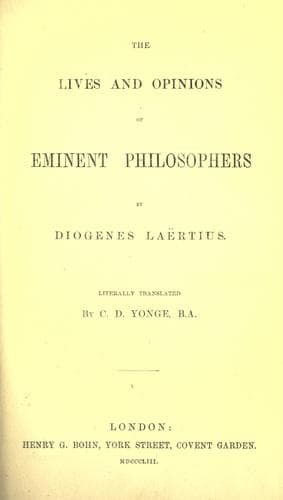
The Lives and Opinions of Eminent PhilosophersDiogenes Laertius
Philosophy
The Lives and Opinions of Eminent Philosophers
Diogenes Laertius
Philosophers, Ancient -- Biography; Philosophy, Ancient
Others say that he, while intending to distribute a polypus to his dogs,
was bitten by them through the tendon of his foot, and so died. But
his own greatest friends, as Antisthenes tells us in his Successions,
rather sanction the story of his having died from holding his breath.
For he used to live in the Craneum, which was a Gymnasium at the gates
of Corinth. And his friends came according to their custom, and found
him with his head covered; and as they did not suppose that he was
asleep, for he was not a man much subject to the influence of night or
sleep, they drew away his cloak from his face, and found him no longer
breathing; and they thought that he had done this on purpose, wishing to
escape the remaining portion of his life.
On this there was a quarrel, as they say, between his friends, as to who
should bury him, and they even came to blows; but when the elders and
chief men of the city came there, they say that he was buried by them at
the gate which leads to the Isthmus. And they placed over him a pillar,
and on that a dog in Parian marble. And at a later period his fellow
citizens honoured him with brazen statues, and put this inscription on
them:—
E’en brass by lapse of time doth old become,
But there is no such time as shall efface
Your lasting glory, wise Diogenes;
Since you alone did teach to men the art
Of a contented life: the surest path
To glory and a lasting happiness.
We ourselves have also written an epigram on him in the proceleusmatic
metre.
_A._ Tell me, Diogenes, tell me true, I pray,
How did you die; what fate to Pluto bore you?
_B._ The savage bite of an envious dog did kill me.
Some, however, say that when he was dying, he ordered his friends to
throw his corpse away without burying it, so that every beast might tear
it, or else to throw it into a ditch, and sprinkle a little dust over it.
And others say that his injunctions were, that he should be thrown into
the Ilissus; that so he might be useful to his brethren. But Demetrius,
in his treatise on Men of the Same Name, says that Diogenes died in
Corinth the same day that Alexander died in Babylon. And he was already
an old man, as early as the hundred and thirteenth olympiad.
XII. The following books are attributed to him. The dialogues entitled
the Cephalion; the Icthyas; the Jackdaw; the Leopard; the People of the
Athenians; the Republic; one called Moral Art; one on Wealth; one on
Love; the Theodorus; the Hypsias; the Aristarchus; one on Death; a volume
of Letters; seven Tragedies, the Helen, the Thyestes, the Hercules, the
Achilles, the Medea, the Chrysippus, and the Œdipus.
Public-domain text, read in full here on John Shaqi.
Reviews
Reviews
No reviews yet
Be the first to share your thoughts on this work.
Elsewhere in the archive
Join the Discussion
Join the discussion
Sign in to leave a comment or review.
Sign InorCreate an account