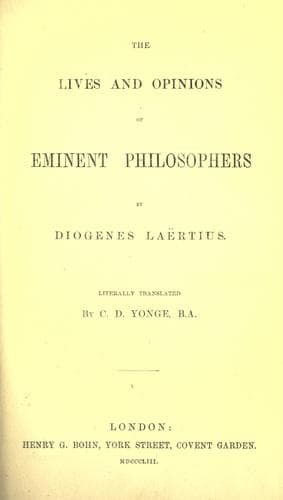
The Lives and Opinions of Eminent PhilosophersDiogenes Laertius
Philosophy
The Lives and Opinions of Eminent Philosophers
Diogenes Laertius
Philosophers, Ancient -- Biography; Philosophy, Ancient
They wished to abolish the whole system of logic and natural philosophy,
like Aristo of Chios, and thought that men should study nothing but
ethics; and what some people assert of Socrates was described by Diocles
as a characteristic of Diogenes, for he said that his doctrine was, that
a man ought to investigate—
Only the good and ill that taketh place
Within our houses.
They also discard all liberal studies. Accordingly, Antisthenes said that
wise men only applied themselves to literature and learning for the sake
of perverting others; they also wish to abolish geometry and music, and
everything of that kind. Accordingly, Diogenes said once to a person who
was showing him a clock; “It is a very useful thing to save a man from
being too late for supper.” And once when a man made an exhibition of
musical skill before him, he said:—
“Cities are governed, so are houses too,
By wisdom, not by harp-playing and whistling.”[80]
Their doctrine is, that the chief good of mankind is to live according to
virtue, as Antisthenes says in his Hercules, in which they resemble the
Stoics. For those two sects have a good deal in common with one another,
on which account they themselves say that cynicism is a short road to
virtue; and Zeno, the Cittiæan lived in the same manner.
They also teach that men ought to live simply, using only plain food in
moderate quantities, wearing nothing but a cloak, and despising riches,
and glory, and nobleness of birth; accordingly some of them feed upon
nothing beyond herbs and cold water, living in any shelter that they can
find, or in tubs as Diogenes did; for he used to say that it was the
peculiar property of the Gods to want nothing, and that, therefore, when
a man wished for nothing he was like the Gods.
Another of their doctrines is, that virtue is a thing which may be
taught, as Antisthenes affirms in his Heraclides; and that when it has
once been attained it can never be lost. They also say that the wise
man deserves to be loved, and cannot commit error, and is a friend to
every one who resembles him, and that he leaves nothing to fortune. And
everything which is unconnected with either virtue or vice they call
indifferent, agreeing in this with Aristo, the Chian.
These then were the Cynics; and now we must pass on to the Stoics, of
which sect the founder was Zeno, who had been a disciple of Crates.
BOOK VII.
LIFE OF ZENO.
I. Zeno was the son of Mnaseas, or Demeas, and a native of Citium, in
Cyprus, which is a Grecian city, partly occupied by a Phœnician colony.
Public-domain text, read in full here on John Shaqi.
Reviews
Reviews
No reviews yet
Be the first to share your thoughts on this work.
Elsewhere in the archive
Join the Discussion
Join the discussion
Sign in to leave a comment or review.
Sign InorCreate an account