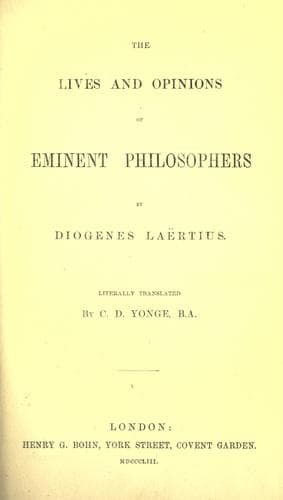
The Lives and Opinions of Eminent PhilosophersDiogenes Laertius
Philosophy
The Lives and Opinions of Eminent Philosophers
Diogenes Laertius
Philosophers, Ancient -- Biography; Philosophy, Ancient
II. He had his head naturally bent on one side, as Timotheus, the
Athenian, tells us, in his work on Lives. And Apollonius, the Tyrian,
says that he was thin, very tall, of a dark complexion; in reference
to which some one once called him an Egyptian Clematis, as Chrysippus
relates in the first volume of his Proverbs: he had fat, flabby, weak
legs, on which account Persæus, in his Convivial Reminiscences, says that
he used to refuse many invitations to supper; and he was very fond, as it
is said, of figs both fresh and dried in the sun.
III. He was a pupil, as has been already stated, of Crates. After that,
they say that he became a pupil of Stilpon and of Xenocrates, for ten
years, as Timocrates relates in his Life of Dion. He is also said to have
been a pupil of Polemo. But Hecaton, and Apollonius, of Tyre, in the
first book of his essay on Zeno, say that when he consulted the oracle,
as to what he ought to do to live in the most excellent manner, the God
answered him that he ought to become of the same complexion as the dead,
on which he inferred that he ought to apply himself to the reading of the
books of the ancients. Accordingly, he attached himself to Crates in the
following manner. Having purchased a quantity of purple from Phœnicia,
he was shipwrecked close to the Piræus; and when he had made his way
from the coast as far as Athens, he sat down by a bookseller’s stall,
being now about thirty years of age. And as he took up the second book
of Xenophon’s Memorabilia and began to read it, he was delighted with
it, and asked where such men as were described in that book lived; and
as Crates happened very seasonably to pass at the moment, the bookseller
pointed him out, and said, “Follow that man.” From that time forth
he became a pupil of Crates; but though he was in other respects very
energetic in his application to philosophy, still he was too modest for
the shamelessness of the Cynics. On which account, Crates, wishing to
cure him of this false shame, gave him a jar of lentil porridge to carry
through the Ceramicus; and when he saw that he was ashamed, and that he
endeavoured to hide it, he struck the jar with his staff, and broke it;
and, as Zeno fled away, and the lentil porridge ran all down his legs,
Crates called after him, “Why do you run away, my little Phœnician,
you have done no harm?” For some time then he continued a pupil of
Crates, and when he wrote his treatise entitled the Republic, some said,
jokingly, that he had written it upon the tail of the dog.
Public-domain text, read in full here on John Shaqi.
Reviews
Reviews
No reviews yet
Be the first to share your thoughts on this work.
Elsewhere in the archive
Join the Discussion
Join the discussion
Sign in to leave a comment or review.
Sign InorCreate an account