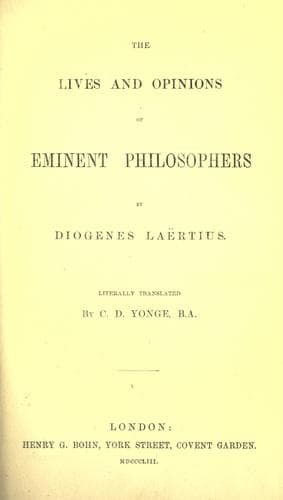
The Lives and Opinions of Eminent PhilosophersDiogenes Laertius
Philosophy
The Lives and Opinions of Eminent Philosophers
Diogenes Laertius
Philosophers, Ancient -- Biography; Philosophy, Ancient
IV. And besides his Republic, he was the author also of the following
works:—a treatise on a Life according to Nature; one on Appetite, or the
Nature of Man; one on Passions; one on the Becoming; one on Law; one on
the usual Education of the Greeks; one on Sight; one on the Whole; one
on Signs; one on the Doctrines of the Pythagoreans; one on Things in
General; one on Styles; five essays on Problems relating to Homer; one
on the Bearing of the Poets. There is also an essay on Art by him, and
two books of Solutions and Jests, and Reminiscences, and one called the
Ethics of Crates. These are the books of which he was the author.
V. But at last he left Crates, and became the pupil of the philosophers
whom I have mentioned before, and continued with them for twenty years.
So that it is related that he said, “I now find that I made a prosperous
voyage when I was wrecked.” But some affirm that he made this speech in
reference to Crates. Others say, that while he was staying at Athens he
heard of a shipwreck, and said, “Fortune does well in having driven us on
philosophy.” But as some relate the affair, he was not wrecked at all,
but sold all his cargo at Athens, and then turned to philosophy.
VI. And he used to walk up and down in the beautiful colonnade which is
called the Peisianactium, and which is also called ποικίλη, from the
paintings of Polygnotus, and there he delivered his discourses, wishing
to make that spot tranquil; for in the time of the thirty, nearly
fourteen hundred of the citizens had been murdered there by them.
VII. Accordingly, for the future, men came thither to hear him, and from
this his pupils were called Stoics, and so were his successors also, who
had been at first called Zenonians, as Epicurus tells us in his Epistles.
And before this time, the poets who frequented this colonnade (στοὰ) had
been called Stoics, as we are informed by Eratosthenes, in the eighth
book of his treatise on the Old Comedy; but now Zeno’s pupils made the
name more notorious. Now the Athenians had a great respect for Zeno, so
that they gave him the keys of their walls, and they also honoured him
with a golden crown, and a brazen statue; and this was also done by his
own countrymen, who thought the statue of such a man an honour to their
city. And the Cittiæans, in the district of Sidon, also claimed him as
their countryman.
VIII. He was also much respected by Antigonus, who, whenever he came to
Athens, used to attend his lectures, and was constantly inviting him to
come to him. But he begged off himself, and sent Persæus, one of his
intimate friends, who was the son of Demetrius, and a Cittiæan by birth,
and who flourished about the hundred and thirtieth olympiad, when Zeno
was an old man. The letter of Antigonus to Zeno was as follows, and it is
reported by Apollonius, the Syrian, in his essay on Zeno.
KING ANTIGONUS TO ZENO THE PHILOSOPHER, GREETING.
Public-domain text, read in full here on John Shaqi.
Reviews
Reviews
No reviews yet
Be the first to share your thoughts on this work.
Elsewhere in the archive
Join the Discussion
Join the discussion
Sign in to leave a comment or review.
Sign InorCreate an account