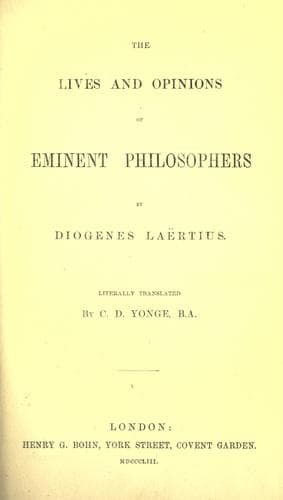
The Lives and Opinions of Eminent PhilosophersDiogenes Laertius
Philosophy
The Lives and Opinions of Eminent Philosophers
Diogenes Laertius
Philosophers, Ancient -- Biography; Philosophy, Ancient
“Since Zeno the son of Mnaseas, the Cittiæan, has passed many years
in the city, in the study of philosophy, being in all other respects
a good man, and also exhorting all the young men who have sought his
company to the practice of virtue, and encouraging them in the practice
of temperance; making his own life a model to all men of the greatest
excellence, since it has in every respect corresponded to the doctrines
which he has taught; it has been determined by the people (and may the
determination be fortunate), to praise Zeno, the son of Mnaseas, the
Cittiæan, and to present him with a golden crown in accordance with the
law, on account of his virtue and temperance, and to build him a tomb in
the Ceramicus, at the public expense. And the people has appointed by
its vote five men from among the citizens of Athens, who shall see to
the making of the crown and the building of the tomb. And the scribe of
the borough shall enrol the decree and engrave it on two pillars, and he
shall be permitted to place one pillar in the Academy, and one in the
Lyceum. And he who is appointed to superintend the work shall divide the
expense that the pillars amount to, in such a way that every one may
understand that the whole people of Athens honours good men both while
they are living and after they are dead. And Thrason of Anacæa, Philocles
of the Piræus, Phædrus of Anaphlystos, Medon of Acharnæ, Micythus of
Sypalettus, and Dion of Pæania, are hereby appointed to superintend the
building of the tomb.”
These then are the terms of the decree.
X. But Antigonus, of Carystos, says, that Zeno himself never denied that
he was a native of Cittium. For that when on one occasion, there was a
citizen of that town who had contributed to the building of some baths,
and was having his name engraved on the pillar, as the countryman of Zeno
the philosopher, he bade them add, “Of Cittium.”
XI. And at another time, when he had had a hollow covering made for some
vessel, he carried it about for some money, in order to procure present
relief for some difficulties which were distressing Crates his master.
And they say that he, when he first arrived in Greece, had more than a
thousand talents, which he lent out at nautical usury.
XII. And he used to eat little loaves and honey, and to drink a small
quantity of sweet smelling wine.
XIII. He had very few youthful acquaintances of the male sex, and he did
not cultivate them much, lest he should be thought to be a misogynist.
And he dwelt in the same house with Persæus; and once, when he brought in
a female flute-player to him, he hastened to bring her back to him.
XIV. And he was, it is said, of a very accommodating temper; so much so,
that Antigonus, the king, often came to dine with him, and often carried
him off to dine with him, at the house of Aristocles the harp-player; but
when he was there, he would presently steal away.
Public-domain text, read in full here on John Shaqi.
Reviews
Reviews
No reviews yet
Be the first to share your thoughts on this work.
Elsewhere in the archive
Join the Discussion
Join the discussion
Sign in to leave a comment or review.
Sign InorCreate an account