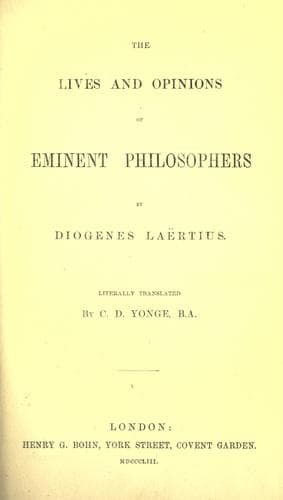
The Lives and Opinions of Eminent PhilosophersDiogenes Laertius
Philosophy
The Lives and Opinions of Eminent Philosophers
Diogenes Laertius
Philosophers, Ancient -- Biography; Philosophy, Ancient
XV. It is also said that he avoided a crowd with great care, so that he
used to sit at the end of a bench, in order at all events to avoid being
incommoded on one side. And he never used to walk with more than two or
three companions. And he used at times to exact a piece of money from all
who came to hear him, with a view of not being distressed by numbers; and
this story is told by Cleanthes, in his treatise on Brazen Money. And
when he was surrounded by any great crowd, he would point to a balustrade
of wood at the end of the colonnade which surrounded an altar, and say,
“That was once in the middle of this place, but it was placed apart
because it was in people’s way; and now, if you will only withdraw from
the middle here, you too will incommode me much less.”
XVI. And when Demochares, the son of Laches, embraced him once, and said
that he would tell Antigonus, or write to him of everything which he
wanted, as he always did everything for him, Zeno, when he had heard him
say this, avoided his company for the future. And it is said, that after
the death of Zeno, Antigonus said, “What a spectacle have I lost.” On
which account he employed Thrason, their ambassador, to entreat of the
Athenians to allow him to be buried in the Ceramicus. And when he was
asked why he had such an admiration for him, he replied, “Because, though
I gave him a great many important presents, he was never elated, and
never humbled.”
XVII. He was a man of a very investigating spirit, and one who inquired
very minutely into everything; in reference to which, Timon, in his
Silli, speaks thus:—
I saw an aged woman of Phœnicia,
Hungry and covetous, in a proud obscurity,
Longing for everything. She had a basket
So full of holes that it retained nothing.
Likewise her mind was less than a skindapsus.[81]
He used to study very carefully with Philo, the dialectician, and to
argue with him at their mutual leisure; on which account he excited the
wonder of the younger Zeno, no less than Diodorus his master.
XVIII. There were also a lot of dirty beggars always about him, as Timon
tells us, where he says:—
Till he collected a vast cloud of beggars,
Who were of all men in the world the poorest,
And the most worthless citizens of Athens.
And he himself was a man of a morose and bitter countenance, with a
constantly frowning expression. He was very economical, and descended
even to the meanness of the barbarians, under the pretence of economy.
Public-domain text, read in full here on John Shaqi.
Reviews
Reviews
No reviews yet
Be the first to share your thoughts on this work.
Elsewhere in the archive
Join the Discussion
Join the discussion
Sign in to leave a comment or review.
Sign InorCreate an account