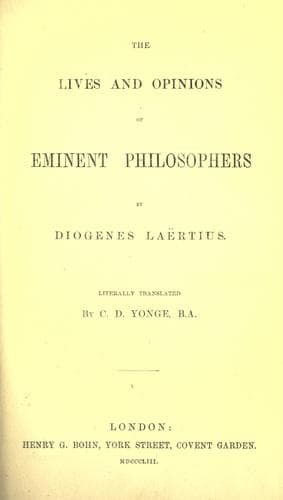
The Lives and Opinions of Eminent PhilosophersDiogenes Laertius
Philosophy
The Lives and Opinions of Eminent Philosophers
Diogenes Laertius
Philosophers, Ancient -- Biography; Philosophy, Ancient
XXXIV. Some again say, that the logical division is properly subdivided
into two sciences, namely, rhetoric and dialectics; and some divide
it also into definitive species, which is conversant with rules and
tests; while others deny the propriety of this last division altogether,
and argue that the object of rules and tests is the discovery of the
truth; for it is in this division that they explain the differences of
representations. They also argue that, on the other side, the science of
definitions has equally for its object the discovery of truth, since we
only know things by the intervention of ideas. They also call rhetoric
a science conversant about speaking well concerning matters which admit
of a detailed narrative; and dialectics they call the science of arguing
correctly in discussions which can be carried on by question and answer;
on which account they define it thus: a knowledge of what is true, and
false, and neither one thing nor the other.
Again, rhetoric itself they divide into three kinds; for one description
they say is concerning about giving advice, another is forensic, and
the third encomiastic; and it is also divided into several parts,
one relating to the discovery of arguments, one to style, one to the
arrangement of arguments, and the other to the delivery of the speech.
And a rhetorical oration they divide into the exordium, the narration,
the reply to the statements of the adverse party, and the peroration.
XXXV. Dialectics, they say, is divided into two parts; one of which has
reference to the things signified, the other to the expression. That
which has reference to the things signified or spoken of, they divide
again into the topic of things conceived in the fancy, and into those
of axioms, of perfect determinations, of predicaments, of things alike,
whether upright or prostrate, of tropes, of syllogisms, and of sophisms,
which are derived either from the voice or from the things. And these
sophisms are of various kinds; there is the false one, the one which
states facts, the negative, the sorites, and others like these; the
imperfect one, the inexplicable one, the conclusive one, the veiled one,
the horned one, the nobody, and the mower.
In the second part of dialectics, that which has for its object the
expression, they treat of written language, of the different parts of a
discourse, of solecism and barbarism, of poetical forms of expression, of
ambiguity, of a melodious voice, of music; and some even add definitions,
divisions, and diction.
Public-domain text, read in full here on John Shaqi.
Reviews
Reviews
No reviews yet
Be the first to share your thoughts on this work.
Elsewhere in the archive
Join the Discussion
Join the discussion
Sign in to leave a comment or review.
Sign InorCreate an account