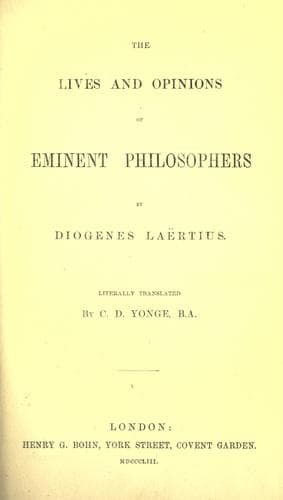
The Lives and Opinions of Eminent PhilosophersDiogenes Laertius
Philosophy
The Lives and Opinions of Eminent Philosophers
Diogenes Laertius
Philosophers, Ancient -- Biography; Philosophy, Ancient
They say that the most useful of these parts is the consideration of
syllogisms; for that they show us what are the things which are capable
of demonstration, and that contributes much to the formation of our
judgment, and their arrangement and memory give a scientific character
to our knowledge. They define reasoning to be a system composed of
assumptions and conclusions: and syllogism is a syllogistic argument
proceeding on them. Demonstration they define to be a method by which
one proceeds from that which is more known to that which is less.
Perception, again, is an impression produced on the mind, its name
being appropriately borrowed from impressions on wax made by a seal;
and perception they divide into comprehensible and incomprehensible:
Comprehensible, which they call the criterion of facts, and which
is produced by a real object, and is, therefore, at the same time
conformable to that object; Incomprehensible, which has no relation
to any real object, or else, if it has any such relation, does not
correspond to it, being but a vague and indistinct representation.
Dialectics itself they pronounce to be a necessary science, and a virtue
which comprehends several other virtues under its species. And the
disposition not to take up one side of an argument hastily, they defined
to be a knowledge by which we are taught when we ought to agree to a
statement, and when we ought to withhold our agreement. Discretion they
consider to be a powerful reason, having reference to what is becoming,
so as to prevent our yielding to an irrelevant argument. Irrefutability
they define to be a power in an argument, which prevents one from being
drawn from it to its opposite. Freedom from vanity, according to them, is
a habit which refers the perceptions back to right reason.
Again, they define knowledge itself as an assertion or safe
comprehension, or habit, which, in the perception of what is seen, never
deviates from the truth. And they say further, that without dialectic
speculation, the wise man cannot be free from all error in his reasoning.
For that that is what distinguishes what is true from what is false, and
which easily detects those arguments which are only plausible, and those
which depend upon an ambiguity of language. And without dialectics they
say it is not possible to ask or answer questions correctly. They also
add, that precipitation in denials extends to those things which are
done, so that those who have not properly exercised their perceptions
fall into irregularity and thoughtlessness. Again, without dialectics,
the wise man cannot be acute, and ingenious, and wary, and altogether
dangerous as an arguer. For that it belongs to the same man to speak
correctly and to reason correctly, and to discuss properly those subjects
which are proposed to him, and to answer readily whatever questions
are put to him, all which qualities belong to a man who is skilful in
dialectics. This then is a brief summary of their opinions on logic.
Public-domain text, read in full here on John Shaqi.
Reviews
Reviews
No reviews yet
Be the first to share your thoughts on this work.
Elsewhere in the archive
Join the Discussion
Join the discussion
Sign in to leave a comment or review.
Sign InorCreate an account