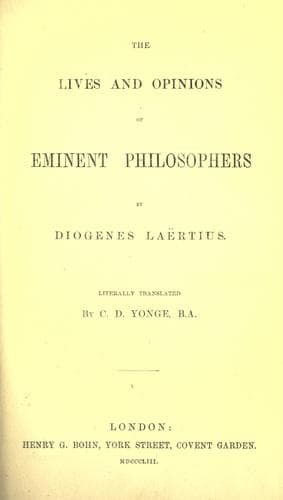
The Lives and Opinions of Eminent PhilosophersDiogenes Laertius
Philosophy
The Lives and Opinions of Eminent Philosophers
Diogenes Laertius
Philosophers, Ancient -- Biography; Philosophy, Ancient
By sensation, the Stoics understand a species of breath which proceeds
from the dominant portion of the soul to the senses, whether it be a
sensible perception, or an organic disposition, which, according to
the notions of some of them, is crippled and vicious. They also call
sensation the energy, or active exercise, of the sense. According to
them, it is to sensation that we owe our comprehension of white and
black, and rough and smooth: from reason, that we derive the notions
which result from a demonstration, those for instance which have for
their object the existence of Gods, and of Divine Providence. For all
our thoughts are formed either by indirect perception, or by similarity,
or analogy, or transposition, or combination, or opposition. By a direct
perception, we perceive those things which are the objects of sense; by
similarity, those which start from some point present to our senses; as,
for instance, we form an idea of Socrates from his likeness. We draw our
conclusions by analogy, adopting either an increased idea of the thing,
as of Tityus, or the Cyclops; or a diminished idea, as of a pigmy. So,
too, the idea of the centre of the world was one derived by analogy
from what we perceived to be the case of the smaller spheres. We use
transposition when we fancy eyes in a man’s breast; combination, when we
take in the idea of a Centaur; opposition, when we turn our thoughts to
death. Some ideas we also derive from comparison, for instance, from a
comparison of words and places.
There is also nature; as by nature we comprehend what is just and
good. And privation, when for instance, we form a notion of a man
without hands. Such are the doctrines of the Stoics, on the subject of
phantasia, and sensation, and thought.
XXXVII. They say that the proper criterion of truth is the comprehension,
φαντασία; that is to say, one which is derived from a real object, as
Chrysippus asserts in the twelfth book of his Physics; and he is followed
by Antipater and Apollodorus. For Boethus leaves a great many criteria,
such as intellect, sensation, appetite, and knowledge; but Chrysippus
dissents from his view, and in the first book of his treatise on Reason,
says, that sensation and preconception are the only criteria. And
preconception is, according to him, a comprehensive physical notion of
general principles. But others of the earlier Stoics admit right reason
as one criterion of the truth; for instance, this is the opinion of
Posidonius, and is advanced by him in his essay on Criteria.
Public-domain text, read in full here on John Shaqi.
Reviews
Reviews
No reviews yet
Be the first to share your thoughts on this work.
Elsewhere in the archive
Join the Discussion
Join the discussion
Sign in to leave a comment or review.
Sign InorCreate an account