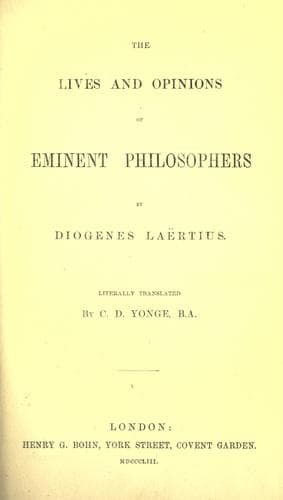
The Lives and Opinions of Eminent PhilosophersDiogenes Laertius
Philosophy
The Lives and Opinions of Eminent Philosophers
Diogenes Laertius
Philosophers, Ancient -- Biography; Philosophy, Ancient
XXXVI. And, that we may also enter into some more minute details
respecting them, we will subjoin what refers to what they call their
introductory science, as it is stated by Diocles, of Magnesia, in his
Excursion of Philosophers, where he speaks as follows, and we will give
his account word for word.
The Stoics have chosen to treat, in the first place, of perception
and sensation, because the criterion by which the truth of facts is
ascertained is a kind of perception, and because the judgment which
expresses the belief, and the comprehension, and the understanding of
a thing, a judgment which precedes all others, cannot exist without
perception. For perception leads the way; and then thought, finding vent
in expressions, explains in words the feelings which it derives from
perception. But there is a difference between φαντασία and φάντασμα. For
φάντασμα is a conception of the intellect, such as takes place in sleep;
but φαντασία is an impression, τύπωσις, produced on the mind, that is
to say, an alteration, ἀλλοίωσις, as Chrysippus states in the twelfth
book of his treatise on the Soul. For we must not take this impression
to resemble that made by a seal, since it is impossible to conceive that
there should be many impressions made at the same time on the same thing.
But φαντασία is understood to be that which is impressed, and formed,
and imprinted by a real object, according to a real object, in such a
way as it could not be by any other than a real object; and, according
to their ideas of the φαντασίαι, some are sensible, and some are not.
Those they call sensible, which are derived by us from some one or more
senses; and those they call not sensible, which emanate directly from the
thought, as for instance, those which relate to incorporeal objects, or
any others which are embraced by reason. Again, those which are sensible,
are produced by a real object, which imposes itself on the intelligence,
and compels its acquiescence; and there are also some others, which are
simply apparent, mere shadows, which resemble those which are produced by
real objects.
Again, these φαντασίαι are divided into rational and irrational; those
which are rational belong to animals capable of reason; those which are
irrational to animals destitute of reason. Those which are rational
are thoughts; those which are irrational have no name; but are again
subdivided into artificial and not artificial. At all events, an image is
contemplated in a different light by a man skilful in art, from that in
which it is viewed by a man ignorant of art.
Public-domain text, read in full here on John Shaqi.
Reviews
Reviews
No reviews yet
Be the first to share your thoughts on this work.
Elsewhere in the archive
Join the Discussion
Join the discussion
Sign in to leave a comment or review.
Sign InorCreate an account