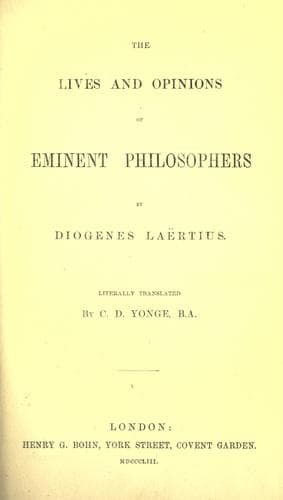
The Lives and Opinions of Eminent PhilosophersDiogenes Laertius
Philosophy
The Lives and Opinions of Eminent Philosophers
Diogenes Laertius
Philosophers, Ancient -- Biography; Philosophy, Ancient
XXXIX. Now of sentences there are five parts, as Diogenes tells us in his
treatise on Voice; and he is followed by Chrysippus. There is the noun,
the common noun, the verb, the conjunction, and the article. Antipater
adds also quality, in his treatise upon Words and the things expressed
by them. And a common noun (προσηγορία) is, according to Diogenes, a
part of a sentence signifying a common quality, as for instance, man,
horse. But a noun is a part of a sentence signifying a peculiar quality,
such as Diogenes, Socrates. A verb is a part of a sentence signifying
an uncombined categorem, as Diogenes (ὁ Διογένης) or, as others define
it, an element of a sentence, devoid of case, signifying something
compound in reference to some person or persons, as, “I write,” “I say.”
A conjunction is a part of a sentence destitute of case, uniting the
divisions of the sentence. An article is an element of a sentence, having
cases, defining the genders of nouns and their numbers, as ὁ, ἡ, τὸ, οἱ,
αἱ, τὰ.
XL. The excellences of a sentence are five,—good Greek, clearness,
conciseness, suitableness, elegance. Good Greek (Ἑλληνισμὸς) is a
correct style, according to art, keeping aloof from any vulgar form of
expression; clearness is a style which states that which is conceived in
the mind in such a way that it is easily known; conciseness is a style
which embraces all that is necessary to the clear explanation of the
subject under discussion; suitableness is a style suited to the subject;
elegance is a style which avoids all peculiarity of expression. Of the
vices of a sentence, on the other hand, barbarism is a use of words
contrary to that in vogue among the well-educated Greeks; solecism is a
sentence incongruously put together.
XLI. A poetical expression is, as Posidonius defines it in his
introduction on Style, “A metrical or rhythmical diction, proceeding
in preparation, and avoiding all resemblance to prose.” For instance,
“The vast and boundless earth,” “Th’ expanse of heaven,” are rhythmical
expressions; and poetry is a collection of poetical expressions
signifying something, containing an imitation of divine and human beings.
Public-domain text, read in full here on John Shaqi.
Reviews
Reviews
No reviews yet
Be the first to share your thoughts on this work.
Elsewhere in the archive
Join the Discussion
Join the discussion
Sign in to leave a comment or review.
Sign InorCreate an account