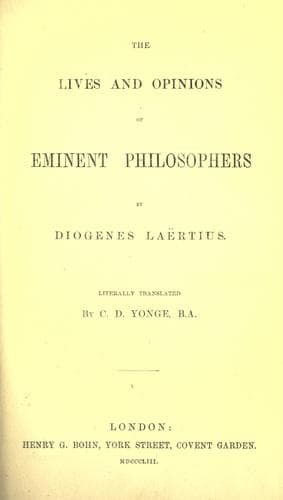
The Lives and Opinions of Eminent PhilosophersDiogenes Laertius
Philosophy
The Lives and Opinions of Eminent Philosophers
Diogenes Laertius
Philosophers, Ancient -- Biography; Philosophy, Ancient
XLII. A definition is, as Antipater explains it in the first book of his
treatise on Definitions, a sentence proceeding by analysis enunciated
in such a way as to give a complete idea; or, as Chrysippus says in his
treatise on Definitions, it is the explanation of an idea. Description is
a sentence which, in a figurative manner, brings one to a knowledge of
the subject, or it may be called a simpler kind of definition, expressing
the power of a definition in plainer language. Genus is a comprehending
of many ideas indissolubly connected, as animal; for this one expression
comprehends all particular kinds of animals. An idea is an imagination of
the mind which does not express actually anything real, or any quality,
but only a _quasi_ reality and a _quasi_ quality; such, for instance, is
the idea of a horse when a horse is not present. Species is that which is
comprehended under genus, as man is comprehended under animal.
Again, that is the most general genus which, being a genus itself, has no
other genus, as the existent. And that is the most special species, which
being a species has no other species, as, for instance, Socrates.
XLIII. The division of genus is a dissection of it into the proximate
species; as, for instance, “Of animals, some are rational, others
irrational.” Contrary division is the dissection of genus into species on
the principle of the contrary; so as to be by a sort of negation; as, for
instance, “Of existent things, some are good and some not good;” and, “Of
things which are not good, some are bad and some indifferent.” Partition
is an arrangement of a genus with reference to place, as Crinis says,
for instance, “Of goods, some have reference to the mind and some to the
body.”
XLIV. Ambiguity (ἀμφιβολία) is an expression signifying two or more
things having an ordinary or a peculiar meaning, according to the
pronunciation, in such a way that more things than one may be understood
by the very same expression. Take, for instance, the words αὐλητρὶς
πέπτωκε. For you may understand by them, a house has fallen down three
times (αὐλὴ τρὶς πέπτωκε), or, a female flute-player has fallen, taking
αὐλητρὶς as synonymous with αὐλητρία.
LV. Dialectics are, as Posidonius explains them, the science of what is
true and false, and neither one or the other, and it is, as Chrysippus
explains it, conversant about words that signify and things that are
signified; these then are the doctrines asserted by the Stoics in their
speculations on the subject of the voice.
XLVI. But in that part of dialectics which concerns things and ideas
signified, they treat of propositions, of perfect enunciations, of
judgments, of syllogisms, of imperfect enunciations, of attributes and
deficiencies, and of both direct and indirect categorems or predicaments.
Public-domain text, read in full here on John Shaqi.
Reviews
Reviews
No reviews yet
Be the first to share your thoughts on this work.
Elsewhere in the archive
Join the Discussion
Join the discussion
Sign in to leave a comment or review.
Sign InorCreate an account