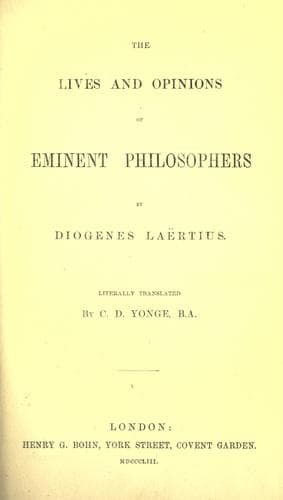
The Lives and Opinions of Eminent PhilosophersDiogenes Laertius
Philosophy
The Lives and Opinions of Eminent Philosophers
Diogenes Laertius
Philosophers, Ancient -- Biography; Philosophy, Ancient
And simple propositions are divided into the affirmative, the negative,
the privative, the categorical, the definite, and the indefinite; those
which are not simple, are divided into the combined, and the adjunctive,
the connected and the disjunctive, and the causal and the augmentative,
and the diminutive. That is an affirmative proposition, “It is not day.”
And the species of this is doubly affirmative. That again is doubly
affirmative, which is affirmative of an affirmative, as for instance, “It
is not not day;” for this amounts to, “It is day.” That is a negative
proposition, which consists of a negative particle and a categorem, as
for instance, “No one is walking.” That is a privative proposition which
consists of a privative particle and an axiom according to power, as
“This man is inhuman.” That is a categorical proposition, which consists
of a nominative case and a categorem, as for instance, “Dion is walking.”
That is a definite proposition, which consists of a demonstrative
nominative case and a categorem, as for instance, “This man is walking.”
That is an indefinite one which consists of an indefinite particle, or
of indefinite particles, as for instance, “Somebody is walking,” “He is
moving.”
Of propositions which are not simple, the combined proposition is, as
Chrysippus states, in his Dialectics, and Diogenes, too, in his Dialectic
Art; that which is held together by the copulative conjunction “if.”
And this conjunction professes that the second member of the sentence
follows the first, as for instance, “If it is day, it is light.” That
which is adjunctive is, as Crinis states in his Dialectic Art, an axiom
which is made to depend on the conjunction “since” (ἐπεὶ), beginning
with an axiom and ending in an axiom, as for instance, “Since it is
day, it is light.” And this conjunction professes both that the second
portion of the proposition follows the first, and the first is true.
That is a connected proposition which is connected by some copulative
conjunctions, as for instance, “It both is day, and it is light.” That
is a disjunctive proposition which is disconnected by the disjunctive
conjunction, “or” (ἤτοι), as for instance, “It is either day or night.”
And this proposition professes that one or other of these propositions
is false. That is a causal proposition which is connected by the word,
“because;” as for instance, “Because it is day, it is light.” For the
first is, as it were, the cause of the second. That is an augmentative
proposition, which explains the greater, which is construed with an
augmentative particle, and which is placed between the two members of
the proposition, as for instance, “It is rather day than night.” The
diminutive proposition is, in every respect, the exact contrary of the
preceding one; as for instance, “It is less night than day.” Again, at
times, axioms or propositions are opposed to one another in respect of
their truth and falsehood, when one is an express denial of the other; as
Public-domain text, read in full here on John Shaqi.
Reviews
Reviews
No reviews yet
Be the first to share your thoughts on this work.
Elsewhere in the archive
Join the Discussion
Join the discussion
Sign in to leave a comment or review.
Sign InorCreate an account