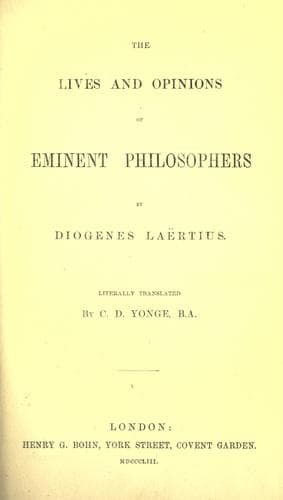
The Lives and Opinions of Eminent PhilosophersDiogenes Laertius
Philosophy
The Lives and Opinions of Eminent Philosophers
Diogenes Laertius
Philosophers, Ancient -- Biography; Philosophy, Ancient
for instance, “It is day,” and, “It is not day.”
Again, a conjunctive proposition is correct, when it is such that the
opposite of the conclusion is contradictory of the premiss; as for
instance, the proposition, “If it is day, it is light,” is true; for,
“It is not light,” which is the opposite to the conclusion expressed, is
contradictory to the premiss, “It is day.” And a conjunctive proposition
is incorrect, when it is such that the opposite of the conclusion is not
inconsistent with the premiss, as for instance, “If it is day, Dion is
walking.” For the fact that Dion is not walking, is not contradictory of
the premiss, “It is day.”
An adjunctive proposition is correct, which begins with a true premiss,
and ends in a consequence which follows of necessity, as for instance,
“Since it is day, the sun is above the earth.” But it is incorrect when
it either begins with a false premiss, or ends with a consequence which
does not follow properly; as for instance, “Since it is night, Dion is
walking,” for this may be said in the day-time.
A causal proposition is correct, when it begins with a true premiss, and
ends in a consequence which necessarily follows from it, but yet does
not have its premiss reciprocally consequent upon its conclusion; as for
instance, “Because it is day, it is light.” For the fact of its being
light, is a necessary consequence of its being day; but the fact of its
being day, is not necessarily a consequence of its being light. A causal
proposition is incorrect, which either begins with a false premiss, or
ends with a conclusion that does not follow from it, or which has a
premiss which does not correspond to the conclusion; as for instance,
“Because it is night, Dion is walking.”
A proposition is persuasive, which leads to the assent of the mind, as
for instance, “If she brought him forth, she is his mother.” But still
this is a falsehood, for a hen is not the mother of an egg. Again, there
are some propositions which are possible, and some which are impossible;
and some which are necessary, and some which are not necessary. That is
possible, which is capable of being true, since external circumstances
are no hindrance to its being true; as for instance, “Diocles lives.” And
that is impossible which is not capable of being true; as for instance,
“The earth flies.” That is necessary which, being true, is not capable
of being false; or perhaps is intrinsically capable of being false,
but still has external circumstances which hinder its being false, as
for instance, “Virtue profits a man.” That again, is not necessary,
which is true, but which has a capacity of being false, though external
circumstances offer no hindrance to either alternative; as for instance,
“Dion walks.”
Public-domain text, read in full here on John Shaqi.
Reviews
Reviews
No reviews yet
Be the first to share your thoughts on this work.
Elsewhere in the archive
Join the Discussion
Join the discussion
Sign in to leave a comment or review.
Sign InorCreate an account