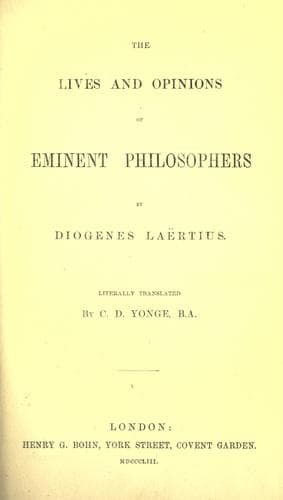
The Lives and Opinions of Eminent PhilosophersDiogenes Laertius
Philosophy
The Lives and Opinions of Eminent Philosophers
Diogenes Laertius
Philosophers, Ancient -- Biography; Philosophy, Ancient
Again, this very thing is the virtue of the happy man and the perfect
happiness of life when everything is done according to a harmony
with the genius of each individual with reference to the will of the
universal governor and manager of all things. Diogenes, accordingly, says
expressly that the chief good is to act according to sound reason in our
selection of things according to our nature. And Archedemus defines it
to be living in the discharge of all becoming duties. Chrysippus again
understands that the nature, in a manner corresponding to which we ought
to live, is both the common nature, and also human nature in particular;
but Cleanthes will not admit of any other nature than the common one
alone, as that to which people ought to live in a manner corresponding;
and repudiates all mention of a particular nature. And he asserts
that virtue is a disposition of the mind always consistent and always
harmonious; that one ought to seek it out for its own sake, without being
influenced by fear or hope by any external influence. Moreover, that it
is in it that happiness consists, as producing in the soul the harmony
of a life always consistent with itself; and that if a rational animal
goes the wrong way, it is because it allows itself to be misled by the
deceitful appearances of exterior things, or perhaps by the instigation
of those who surround it; for nature herself never gives us any but good
inclinations.
LIV. Now virtue is, to speak generally, a perfection in everything, as
in the case of a statue; whether it is invisible as good health, or
speculative as prudence. For Hecaton says, in the first book of his
treatise on Virtues, that the scientific and speculative virtues are
those which have a constitution arising from speculation and study,
as, for instance, prudence and justice; and that those which are not
speculative are those which are generally viewed in their extension as a
practical result or effect of the former; such for instance, as health
and strength. Accordingly, temperance is one of the speculative virtues,
and it happens that good health usually follows it, and is marshalled
as it were beside it; in the same way as strength follows the proper
structure of an arch.—And the unspeculative virtues derive their name
from the fact of their not proceeding from any acquiescence reflected by
intelligence; but they are derived from others, are only accessories,
and are found even in worthless people, as in the case of good health,
or courage. And Posidonius, in the first book of his treaties on Ethics,
says that the great proof of the reality of virtue is that Socrates, and
Diogenes, and Antisthenes, made great improvement; and the great proof
of the reality of vice may be found in the fact of its being opposed to
virtue.
Public-domain text, read in full here on John Shaqi.
Reviews
Reviews
No reviews yet
Be the first to share your thoughts on this work.
Elsewhere in the archive
Join the Discussion
Join the discussion
Sign in to leave a comment or review.
Sign InorCreate an account