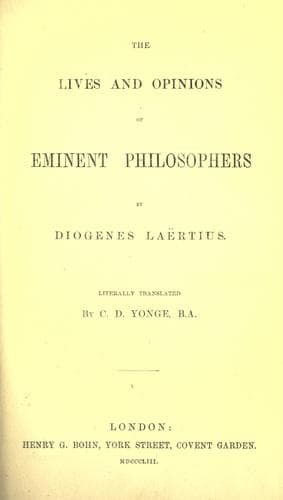
The Lives and Opinions of Eminent PhilosophersDiogenes Laertius
Philosophy
The Lives and Opinions of Eminent Philosophers
Diogenes Laertius
Philosophers, Ancient -- Biography; Philosophy, Ancient
LII. They say that the first inclination which an animal has is to
protect itself, as nature brings herself to take an interest in it from
the beginning, as Chrysippus affirms in the first book of his treatise on
Ends; where he says, that the first and dearest object to every animal
is its own existence, and its consciousness of that existence. For that
it is not natural for any animal to be alienated from itself, or even
to be brought into such a state as to be indifferent to itself, being
neither alienated from nor interested in itself. It remains, therefore,
that we must assert that nature has bound the animal to itself by the
greatest unanimity and affection; for by that means it repels all that
is injurious, and attracts all that is akin to it and desirable. But as
for what some people say, that the first inclination of animals is to
pleasure, they say what is false. For they say that pleasure, if there
be any such thing at all, is an accessory only, which, nature, having
sought it out by itself, as well as those things which are adapted to its
constitution, receives incidentally in the same manner as animals are
pleased, and plants made to flourish.
Moreover, say they, nature makes no difference between animals and
plants, when she regulates them so as to leave them without voluntary
motion or sense; and some things too take place in ourselves in the same
manner as in plants. But, as inclination in animals tends chiefly to the
point of making them pursue what is appropriate to them, we may say that
their inclinations are regulated by nature. And as reason is given to
rational animals according to a more perfect principle, it follows, that
to live correctly according to reason, is properly predicated of those
who live according to nature. For nature is as it were the artist who
produces the inclination.
LIII. On which account Zeno was the first writer who, in his treatise
on the Nature of Man, said, that the chief good was confessedly to live
according to nature; which is to live according to virtue, for nature
leads us to this point. And in like manner Cleanthes speaks in his
treatise on Pleasure, and so do Posidonius and Hecaton in their essays
on Ends as the Chief Good. And again, to live according to virtue is
the same thing as living according to one’s experience of those things
which happen by nature; as Chrysippus explains it in the first book of
his treatise on the Chief Good. For our individual natures are all parts
of universal nature; on which account the chief good is to live in a
manner corresponding to nature, and that means corresponding to one’s
own nature and to universal nature; doing none of those things which the
common law of mankind is in the habit of forbidding, and that common law
is identical with that right reason which pervades everything, being the
same with Jupiter, who is the regulator and chief manager of all existing
things.
Public-domain text, read in full here on John Shaqi.
Reviews
Reviews
No reviews yet
Be the first to share your thoughts on this work.
Elsewhere in the archive
Join the Discussion
Join the discussion
Sign in to leave a comment or review.
Sign InorCreate an account