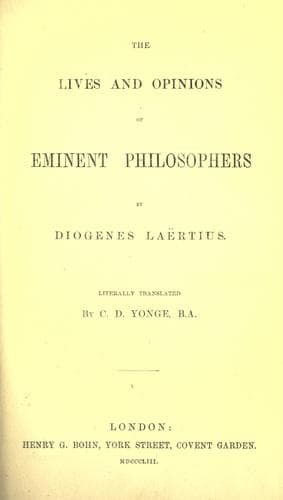
The Lives and Opinions of Eminent PhilosophersDiogenes Laertius
Philosophy
The Lives and Opinions of Eminent Philosophers
Diogenes Laertius
Philosophers, Ancient -- Biography; Philosophy, Ancient
At another time, they define the good in a peculiar manner, as being what
is perfect according to the nature of a rational being as rational being.
And, secondly, they say that it is conformity to virtue, so that all
actions which partake of virtue, and all good men, are themselves in some
sense the good. And in the third place, they speak of its accessories,
joy, and mirth, and things of that kind. In the same manner they speak of
vices, which they divide into folly, cowardice, injustice, and things of
that kind. And they consider that those things which partake of vices,
and actions done according to vice, and bad men, are themselves in some
sense the evil; and its accessories are despondency, and melancholy, and
other things of that kind.
LVI. Again, of goods, some have reference to the mind, and some are
external; and some neither have reference to the mind, nor are external.
The goods having reference to the mind are virtues, and actions according
to the virtues. The external goods are the having a virtuous country, a
virtuous friend, and the happiness of one’s country and friend. And those
which are not external, and which have no reference to the mind, are
such as a man’s being virtuous and happy to himself. And reciprocally,
of evils, some have reference to the mind, such as the vices and actions
according to them; some are external, such as having a foolish country,
or a foolish friend, or one’s country or one’s friend being unhappy. And
those evils which are not external, and which have no reference to the
mind, are such as a man’s being worthless and unhappy to himself.
LVII. Again, of goods, some are final, some are efficient, and some are
both final and efficient. For instance, a friend, and the services
done by him to one, are efficient goods; but courage, and prudence, and
liberty, and delight, and mirth, and freedom from pain, and all kinds of
actions done according to virtue, are final goods. There are too, as I
said before, some goods which are both efficient and final; for inasmuch
as they produce perfect happiness they are efficient, and inasmuch as
they complete it by being themselves parts of it, they are final. And
in the same way, of evils, some are final, and some efficient, and some
partake of both natures. For instance, an enemy and the injuries done to
one by him, are efficient evils; fear, meanness of condition, slavery,
want of delight, depression of spirits, excessive grief, and all actions
done according to vice, are final evils; and some partake of both
characters, since, inasmuch as they produce perfect unhappiness, they are
efficient; and inasmuch as they complete it in such a way as to become
parts of it, they are final.
Public-domain text, read in full here on John Shaqi.
Reviews
Reviews
No reviews yet
Be the first to share your thoughts on this work.
Elsewhere in the archive
Join the Discussion
Join the discussion
Sign in to leave a comment or review.
Sign InorCreate an account