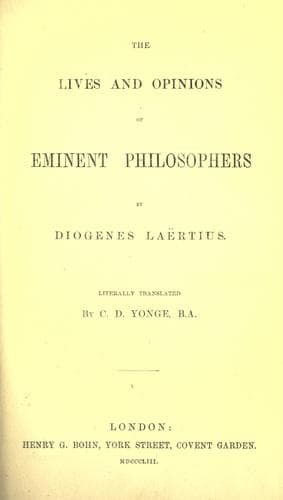
The Lives and Opinions of Eminent PhilosophersDiogenes Laertius
Philosophy
The Lives and Opinions of Eminent Philosophers
Diogenes Laertius
Philosophers, Ancient -- Biography; Philosophy, Ancient
LVIII. Again, of the goods which have reference to the mind, some
are habits, some are dispositions, and some are neither habits nor
dispositions. Dispositions are virtues, habits are practices, and those
which are neither habits nor dispositions are energies. And, speaking
generally, the following may be called mixed goods: happiness in one’s
children, and a happy old age. But knowledge is a pure good. And some
goods are continually present, such as virtue; and some are not always
present, as joy, or taking a walk.
LIX. But every good is expedient, and necessary, and profitable, and
useful, and serviceable, and beautiful, and advantageous, and eligible,
and just. Expedient, inasmuch as it brings us things, which by their
happening to us do us good; necessary, inasmuch as it assists us in
what we have need to be assisted; profitable, inasmuch as it repays all
the care that is expended on it, and makes a return with interest to
our great advantage; useful, inasmuch as it supplies us with what is of
utility; serviceable, because it does us service which is much praised;
beautiful, because it is in accurate proportion to the need we have of
it, and to the service it does. Advantageous, inasmuch as it is of such a
character as to confer advantage on us; eligible, because it is such that
we may rationally choose it; and just, because it is in accordance with
law, and is an efficient cause of union.
And they call the honourable the perfect good, because it has naturally
all the numbers which are required by nature, and because it discloses
a perfect harmony. Now, the species of this perfect good are four in
number: justice, manly courage, temperance, and knowledge; for in these
goods all beautiful actions have their accomplishment. And analogously,
there are also four species of the disgraceful: injustice, and cowardice,
and intemperance, and folly. And the honourable is predicated in one
sense, as making those who are possessed of it worthy of all praise; and
in a second sense, it is used of what is well adapted by nature for its
proper work; and in another sense, when it expresses that which adorns a
man, as when we say that the wise man alone is good and honourable.
The Stoics also say, that the beautiful is the only good, as Hecaton
says, in the third book of his treatise on Goods, and Chrysippus asserts
the same principle in his essays on the Beautiful. And they say that this
is virtue, and that which partakes of virtue; and this assertion is equal
to the other, that everything good is beautiful, and that the good is an
equivalent term to the beautiful, inasmuch as the one thing is exactly
equal to the other. For since it is good, it is beautiful; and it is
beautiful, therefore, it is good.
Public-domain text, read in full here on John Shaqi.
Reviews
Reviews
No reviews yet
Be the first to share your thoughts on this work.
Elsewhere in the archive
Join the Discussion
Join the discussion
Sign in to leave a comment or review.
Sign InorCreate an account