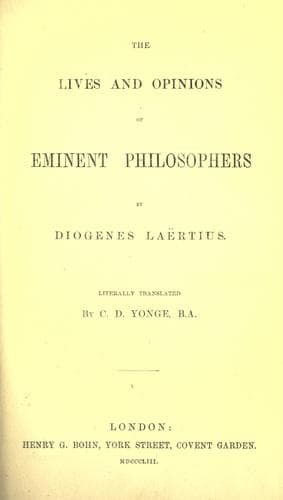
The Lives and Opinions of Eminent PhilosophersDiogenes Laertius
Philosophy
The Lives and Opinions of Eminent Philosophers
Diogenes Laertius
Philosophers, Ancient -- Biography; Philosophy, Ancient
LX. But it seems that all goods are equal, and that every good is to be
desired in the highest degree, and that it admits of no relaxation, and
of no extension. Moreover, they divide all existing things into good,
bad, and indifferent. The good are the virtues, prudence, justice, manly
courage, temperance, and the rest of the like qualities. The bad are the
contraries, folly, injustice, and the like. Those are indifferent which
are neither beneficial nor injurious, such as life, health, pleasure,
beauty, strength, riches, a good reputation, nobility of birth; and their
contraries, death, disease, labour, disgrace, weakness, poverty, a bad
reputation, baseness of birth, and the like; as Hecaton lays it down in
the seventh book of his treatise on the Chief Good; and he is followed by
Apollodorus, in his Ethics, and by Chrysippus. For they affirm that those
things are not good but indifferent, though perhaps a little more near to
one species than to the other.
For, as it is the property of the hot to warm and not to chill one, so
it is the property of the good to benefit and not to injure one. Now,
wealth and good health cannot be said to benefit any more than to injure
any one: therefore, neither wealth nor good health are goods. Again,
they say that that thing is not good which it is possible to use both
well and ill. But it is possible to make either a good or a bad use of
wealth, or of health; therefore, wealth and good health are not goods.
Posidonius, however, affirms that these things do come under the head of
goods. But Hecaton, in the nineteenth book of his treatise on Goods, and
Chrysippus, in his treatises on Pleasure, both deny that pleasure is a
good. For they say that there are disgraceful pleasures, and that nothing
disgraceful is good. And that to benefit a person is to move him or to
keep him according to virtue, but to injure him is to move him or to keep
him according to vice.
They also assert, that things indifferent are so spoken of in a twofold
manner; firstly, those things are called so, which have no influence in
producing either happiness or unhappiness; such for instance, as riches,
glory, health, strength, and the like; for it is possible for a man to
be happy without any of these things; and also, it is upon the character
of the use that is made of them, that happiness or unhappiness depends.
In another sense, those things are called indifferent, which do not
excite any inclination or aversion, as for instance, the fact of a man’s
having an odd or an even number of hairs on his head, or his putting
out or drawing back his finger; for it is not in this sense that the
things previously mentioned are called indifferent, for they do excite
inclination or aversion. On which account some of them are chosen, though
there is equal reason for preferring or shunning all the others.
Public-domain text, read in full here on John Shaqi.
Reviews
Reviews
No reviews yet
Be the first to share your thoughts on this work.
Elsewhere in the archive
Join the Discussion
Join the discussion
Sign in to leave a comment or review.
Sign InorCreate an account