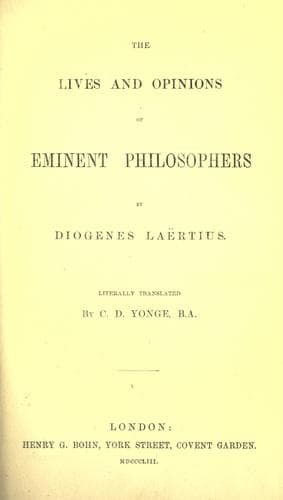
The Lives and Opinions of Eminent PhilosophersDiogenes Laertius
Philosophy
The Lives and Opinions of Eminent Philosophers
Diogenes Laertius
Philosophers, Ancient -- Biography; Philosophy, Ancient
They are also, as they say, godlike; for they have something in them
which is as it were a God. But the bad man is an atheist. Now there are
two kinds of atheists; one who speaks in a spirit of hostility to, and
the other, who utterly disregards, the divine nature; but they admit
that all bad men are not atheists in this last sense. The good, on the
contrary, are pious; for they have a thorough acquaintance with the laws
respecting the Gods. And piety is a knowledge of the proper reverence
and worship due to the Gods. Moreover they sacrifice to the Gods, and
keep themselves pure; for they avoid all offences having reference to
the Gods, and the Gods admire them; for they are holy and just in all
that concerns the Deity; and the wise men are the only priests; for they
consider the matters relating to sacrifices, and the erection of temples,
and purifications, and all other things which peculiarly concern the
Gods. They also pronounce that men are bound to honour their parents,
and their brethren, in the second place after the Gods. They also say
that parental affection for one’s children is natural to them, and is a
feeling which does not exist in bad men. And they lay down the position
that all offences are equal, as Chrysippus argues in the fourth book of
his Ethic Questions, and so say Persæus and Zeno. For if one thing that
is true is not more true than another thing that is true, neither is one
thing that is false more false than another thing that is false; so too,
one deceit is not greater than another, nor one sin than another. For the
man who is a hundred furlongs from Canopus, and the man who is only one,
are both equally not in Canopus; and so too, he who commits a greater
sin, and he who commits a less, are both equally not in the right path.
Heraclides of Tarsus, indeed, the friend of Antipater, of Tarsus, and
Athenodorus, both assert that offences are not equal.
Again, the Stoics, as for instance, Chrysippus, in the first book of his
work on Lives, say, that the wise man will take a part in the affairs of
the state, if nothing hinders him. For that he will restrain vice, and
excite men to virtue. Also, they say that he will marry, as Zeno says,
in his Republic, and beget children. Moreover, that the wise man will
never form mere opinions, that is to say, he will never agree to anything
that is false; and that he will become a Cynic; for that Cynicism is a
short path to virtue, as Apollodorus calls it in his Ethics; that he
will even eat human flesh, if there should be occasion; that he is the
only free man, and that the bad are slaves; for that freedom is a power
of independent action, but slavery a deprivation of the same. That there
is besides, another slavery, which consists in subjection, and a third
which consists in possession and subjection; the contrary of which is
masterhood, which is likewise bad.
Public-domain text, read in full here on John Shaqi.
Reviews
Reviews
No reviews yet
Be the first to share your thoughts on this work.
Elsewhere in the archive
Join the Discussion
Join the discussion
Sign in to leave a comment or review.
Sign InorCreate an account