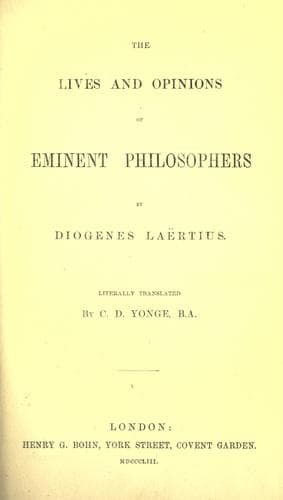
The Lives and Opinions of Eminent PhilosophersDiogenes Laertius
Philosophy
The Lives and Opinions of Eminent Philosophers
Diogenes Laertius
Philosophers, Ancient -- Biography; Philosophy, Ancient
And they say, that not only are the wise free, but that they are also
kings, since kingly power is an irresponsible dominion, which can only
exist in the case of the wise man, as Chrysippus says in his treatise
on the Proper Application of his Terms made by Zeno; for he says that
a ruler ought to give decisions on good and evil, and that none of the
wicked understand these things. In the same way, they assert that they
are the only people who are fit to be magistrates or judges, or orators,
and that none of the bad are qualified for these tasks. Moreover, that
they are free from all error, in consequence of their not being prone to
any wrong actions. Also, that they are unconnected with injury, for that
they never injure any one else, nor themselves. Also, that they are not
pitiful, and that they never make allowance for any one; for that they do
not relax the punishments appointed by law, since yielding, and pity, and
mercifulness itself, never exist in any of their souls, so as to induce
an affectation of kindness in respect of punishment; nor do they ever
think any punishment too severe. Again, they say that the wise man never
wonders at any of the things which appear extraordinary; as for instance,
at the stories about Charon, or the ebbing of the tide, or the springs
of hot water, or the bursting forth of flames. But, say they further,
the wise man will not live in solitude; for he is by nature sociable and
practical. Accordingly, he will take exercise for the sake of hardening
and invigorating his body. And the wise man will pray, asking good things
from the Gods, as Posidonius says in the first book of his treatise on
Duties, and Hecaton says the same thing in the thirteenth book of his
treatise on Extraordinary Things.
They also say, that friendship exists in the virtuous alone, on account
of their resemblance to one another. And they describe friendship itself
as a certain communion of the things which concern life, since we use
our friends as ourselves. And they assert that a friend is desirable for
his own sake, and that a number of friends is a good; and that among the
wicked there is no such thing as friendship, and that no wicked man can
have a friend.
Again, they say that all the foolish are mad; for that they are not
prudent, and that madness is equivalent to folly in every one of its
actions; but that the wise man does everything properly, just as we say
that Ismenias can play every piece of flute-music well. Also, they say
that everything belongs to the wise man, for that the law has given them
perfect and universal power; but some things also are said to belong to
the wicked, just in the same manner as some things are said to belong
to the unjust, or as a house is said to belong to a city in a different
sense from that in which a thing belongs to the person who uses it.
Public-domain text, read in full here on John Shaqi.
Reviews
Reviews
No reviews yet
Be the first to share your thoughts on this work.
Elsewhere in the archive
Join the Discussion
Join the discussion
Sign in to leave a comment or review.
Sign InorCreate an account