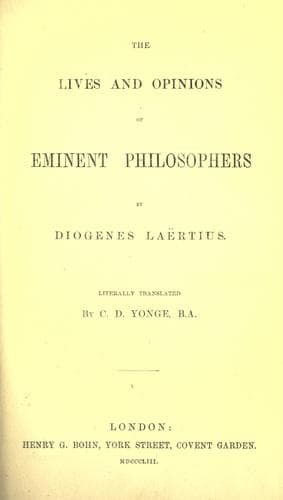
The Lives and Opinions of Eminent PhilosophersDiogenes Laertius
Philosophy
The Lives and Opinions of Eminent Philosophers
Diogenes Laertius
Philosophers, Ancient -- Biography; Philosophy, Ancient
The topic which examines into causes they say is also divisible into
two parts; and with reference to one of its considerations, the
investigations of physicians partake of it; according to which it is
that they investigate the dominant principle of the soul, and the
things which exist in the soul, and seeds, and things of this kind.
And its other division is claimed as belonging to them also by the
mathematicians, as, for instance, how we see, what is the cause of our
appearance being reflected in a mirror, how clouds are collected, how
thunder is produced, and the rainbow, and the halo, and comets, and
things of that kind.
LXVIII. They think that there are two general principles in the universe,
the active and the passive. That the passive is matter, an existence
without any distinctive quality. That the active is the reason which
exists in the passive, that is to say, God. For that he, being eternal,
and existing throughout all matter, makes everything. And Zeno, the
Cittiæan, lays down this doctrine in his treatise on Essence, and so does
Cleanthes in his essay on Atoms, Chrysippus in the first book of his
Investigations in Natural Philosophy, towards the end, Archedemus in his
work on Elements, and Posidonius in the second book of his treatise on
Natural Philosophy. But they say that principles and elements differ from
one another. For that the one had no generation or beginning, and will
have no end; but that the elements may be destroyed by the operation of
fire. Also, that the elements are bodies, but principles have no bodies
and no forms, and elements too have forms.
Now a body, says Apollodorus in his Natural Philosophy, is extended in
a threefold manner; in length, in breadth, in depth; and then it is
called a solid body; and the superficies is the limit of the body having
length and breadth alone, but not depth. But Posidonius, in the third
book of his Heavenly Phænomena, will not allow a superficies either
any substantial reality, or any intelligible existence. A line is the
limit of a superficies, or length without breadth, or something which
has nothing but length. A point is the boundary of a line, and is the
smallest of all symbols.
They also teach that God is unity, and that he is called Mind, and Fate,
and Jupiter, and by many other names besides. And that, as he was in the
beginning by himself, he turned into water the whole substance which
pervaded the air; and as the seed is contained in the produce, so too, he
being the seminal principle of the world, remained behind in moisture,
making matter fit to be employed by himself in the production of those
things which were to come after; and then, first of all, he made the
four elements, fire, water, air, and earth. And Zeno speaks of these in
his treatise on the Universe, and so does Chrysippus in the first book of
his Physics, and so does Archedemus in some treatise on the Elements.
Public-domain text, read in full here on John Shaqi.
Reviews
Reviews
No reviews yet
Be the first to share your thoughts on this work.
Elsewhere in the archive
Join the Discussion
Join the discussion
Sign in to leave a comment or review.
Sign InorCreate an account