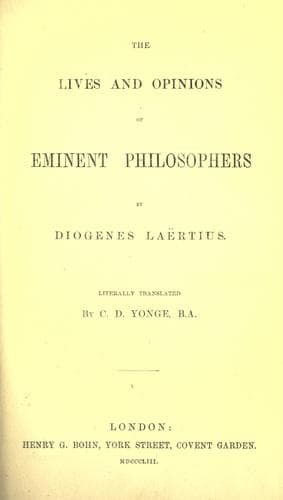
The Lives and Opinions of Eminent PhilosophersDiogenes Laertius
Philosophy
The Lives and Opinions of Eminent Philosophers
Diogenes Laertius
Philosophers, Ancient -- Biography; Philosophy, Ancient
And as there are three kinds of lives; the theoretical, the practical,
and the logical; they say that the last is the one which ought to be
chosen. For that a logical, that is a rational, animal was made by nature
on purpose for speculation and action. And they say that a wise man will
very rationally take himself out of life, either for the sake of his
country or of his friends, or if he be in bitter pain, or under the
affliction of mutilation, or incurable disease. And they also teach that
women ought to be in common among the wise, so that whoever meets with
any one may enjoy her, and this doctrine is maintained by Zeno in his
Republic, and by Chrysippus in his treatise on Polity, and by Diogenes
the Cynic, and by Plato; and then, say they, we shall love all boys
equally after the manner of fathers, and all suspicion on the ground of
undue familiarity will be removed.
They affirm too, that the best of political constitutions is a mixed one,
combined of democracy, and kingly power, and aristocracy. And they say
many things of this sort, and more too, in their Ethical Dogmas, and they
maintain them by suitable explanations and arguments. But this may be
enough for us to say of their doctrines on this head by way of summary,
and taking them in an elementary manner.
LXVII. They divide natural philosophy into the topics of bodies, and
of principles, and of elements, and of Gods, and of boundaries, and of
place, and of the vacuum. And they make these divisions according to
species; but according to genera they divide them into three topics,
that of the world, that of the elements, and the third is that which
reasons on causes. The topic about the world, they say, is subdivided
into two parts. For that in one point of view, the mathematicians also
have a share in it; and according to it it is that they prosecute their
investigations into the nature of the fixed stars and the planets; as,
for instance, whether the sun is of such a size as he appears to be, and
similarly, whether the moon is; and in the same way they investigate
the question of spherical motion, and others of the same character. The
other point of view is that which is reserved exclusively for natural
philosophers, according to which it is that the existence and substance
of things are examined, [for instance, whether the sun and the stars
consist of matter and form,] and whether the sun is born or not born,
whether it is living or lifeless, corruptible or incorruptible, whether
it is regulated by Providence, and other questions of this kind.
Public-domain text, read in full here on John Shaqi.
Reviews
Reviews
No reviews yet
Be the first to share your thoughts on this work.
Elsewhere in the archive
Join the Discussion
Join the discussion
Sign in to leave a comment or review.
Sign InorCreate an account