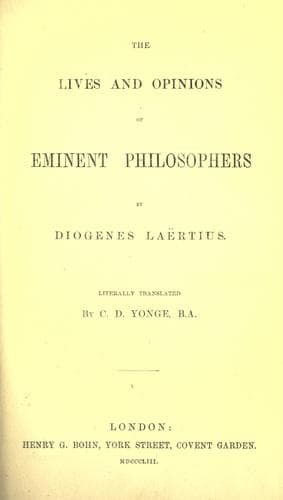
The Lives and Opinions of Eminent PhilosophersDiogenes Laertius
Philosophy
The Lives and Opinions of Eminent Philosophers
Diogenes Laertius
Philosophers, Ancient -- Biography; Philosophy, Ancient
LXXXIV. Another of their doctrines is that nature is an artificial fire
tending by a regular road to production, which is a fiery kind of breath
proceeding according to art. Also, that the soul is sensible, and that
it is a spirit which is born with us; consequently it is a body and
continues to exist after death; that nevertheless it is perishable. But
that the soul of the universe is imperishable, and that the souls which
exist in animals are only parts of that of the universe. But Zeno, the
Cittiæan, and Antipater, in their treatise concerning the Soul, and
Posidonius also, all say that the soul is a warm spirit; for that by
it we have our breath, and by it we are moved. Cleanthes, accordingly,
asserts that all souls continue to exist till they are burnt up; but
Chrysippus says that it is only the souls of the wise that endure. And
they further teach that there are eight parts of the soul; the five
senses, and the generative faculties, and voice, and reason. And we see
because of a body of luminous air which extends from the organ of sight
to the object in a conical form, as it is asserted by Chrysippus, in the
second book of his Natural Philosophy, and also by Apollodorus. And the
apex of this cone is close to the eye, and its base is formed by the
object which is seen; so that that which is seen is as it were reported
to the eye by this continuous cone of air extended towards it like a
staff. In the same way, we hear because the air between the speaker and
the hearer is struck in a spherical manner; and is then agitated in
waves, resembling the circular eddies which one sees in a cistern when a
stone is dropped into it.
Sleep, they say, is produced by a relaxation of the æsthetic energies
with reference to the dominant part of the soul. And the causes of the
passions they explain to be the motions and conversions which take place
in connection with this spirit or soul.
LXXXV. Seed, they define as a thing of a nature capable of producing
other things of the same nature as the thing from which it has been
separated. And the seed of man, which man emits, is, together with
moisture, mixed up with the parts of the soul by that kind of mixture
which corresponds to the capacity of the parents. And Chrysippus says,
in the second book of his Natural Philosophy, that it is a spirit
according to substance; as is manifest from the seeds which are planted
in the earth; and which, if they are old, do not germinate, because all
their virtue has evaporated. And Sphærus says, that seed proceeds from
the entire body, and that that is how it is that it produces all the
parts of the body.
They also say that the seed of the female is unproductive; for, as
Sphærus says, it is devoid of tone, and small in quantity, and watery.
LXXXVI. They also say that that is the dominant part of the soul which is
its most excellent part; in which the imaginations and the desires are
formed, and whence reason proceeds. And this place is in the heart.
Public-domain text, read in full here on John Shaqi.
Reviews
Reviews
No reviews yet
Be the first to share your thoughts on this work.
Elsewhere in the archive
Join the Discussion
Join the discussion
Sign in to leave a comment or review.
Sign InorCreate an account