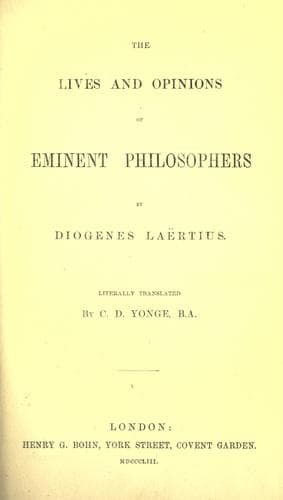
The Lives and Opinions of Eminent PhilosophersDiogenes Laertius
Philosophy
The Lives and Opinions of Eminent Philosophers
Diogenes Laertius
Philosophers, Ancient -- Biography; Philosophy, Ancient
These then are the doctrines on the subject of natural philosophy
entertained by them, which it seems sufficient for us to detail, having
regard to the due proportions of this book. And the following are the
points in which some of them disagreed with the rest.
LIFE OF ARISTON.
I. Ariston the Bald, a native of Chios, surnamed the Siren, said, that
the chief good was to live in perfect indifference to all those things
which are of an intermediate character between virtue and vice; making
not the slightest difference between them, but regarding them all on a
footing of equality. For that the wise man resembles a good actor; who,
whether he is filling the part of Agamemnon or Thersites, will perform
them both equally well.
II. And he discarded altogether the topic of physics, and of logic,
saying that the one was above us, and that the other had nothing to do
with us; and that the only branch of philosophy with which we had any
real concern was ethics.
III. He also said that dialectic reasonings were like cobwebs; which,
although they seem to be put together on principles of art, are utterly
useless.
IV. And he did not introduce many virtues into his scheme, as Zeno did;
nor one virtue under a great many names, as the Megaric philosophers did;
but defined virtue as consisting in behaving in a certain manner with
reference to a certain thing.
V. And as he philosophized in this manner, and carried on his discussions
in the Cynosarges, he got so much influence as to be called a founder of
a sect. Accordingly, Miltiades, and Diphilus were called Aristoneans.
VI. He was a man of very persuasive eloquence, and one who could adapt
himself well to the humours of a multitude. On which account Timon says
of him:—
And one who, from Ariston’s wily race,
Traced his descent.
Diocles, the Magnesian, tells us that Ariston having fallen in with
Polemo, passed over to his school, at a time when Zeno was lying ill
with a long sickness. The Stoic doctrine to which he was most attached,
was the one that the wise man is never guided by opinions. But Persæus
argued against this, and caused one of two twin brothers to place a
deposit in his hands, and then caused the other to reclaim it; and thus
he convicted him, as he was in doubt on this point, and therefore forced
to act on opinion. He was a great enemy of Arcesilaus. And once, seeing
a bull of a monstrous conformation, having a womb, he said, “Alas! here
is an argument for Arcesilaus against the evidence of his senses.” On
another occasion, when a philosopher of the Academy said that he did not
comprehend anything, he said to him, “Do not you even see the man who is
sitting next to you?” And as he said that he did not, he said:—
Who then has blinded you, who’s been so harsh,
As thus to rob you of your beaming eyes?
Public-domain text, read in full here on John Shaqi.
Reviews
Reviews
No reviews yet
Be the first to share your thoughts on this work.
Elsewhere in the archive
Join the Discussion
Join the discussion
Sign in to leave a comment or review.
Sign InorCreate an account