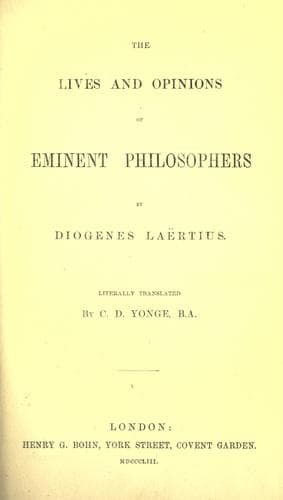
The Lives and Opinions of Eminent PhilosophersDiogenes Laertius
Philosophy
The Lives and Opinions of Eminent Philosophers
Diogenes Laertius
Philosophers, Ancient -- Biography; Philosophy, Ancient
II. He was the son of Theophantus, and a native of Heraclea.
III. He was a pupil, as we are told by Diocles, first of all of
Heraclides, his fellow citizen; after that of Alexinus, and Menedemus;
and last of all of Zeno. And at first, as he was very devoted to
learning, he tried his hand at all kinds of poetry. Afterwards, he
attached himself to Aratus, whom he took for his model. Having left Zeno,
he turned to the Cyrenaics, and became a frequenter of brothels, and in
other respects indulged in luxury without disguise.
IV. When he had lived near eighty years, he died of starvation.
V. The following books are attributed to him. Two books on Apathy; two
on Exercise; four on Pleasure; one on Riches, and Favours, and Revenge;
one on the Use of Men; one on Good Fortune; one on Ancient Kings; one on
Things which are Praised; one on Barbarian Customs.
These now are the chief men who differed from the Stoics. But the man who
succeeded Zeno in his school was Cleanthes, whom we must now speak of.
LIFE OF CLEANTHES
I. Cleanthes was a native of Assos, and the son of Phanias. He was
originally a boxer, as we learn from Antisthenes, in his Successions.
And he came to Athens, having but four drachmas, as some people say, and
attaching himself to Zeno, he devoted himself to Philosophy in a most
noble manner; and he adhered to the same doctrines as his master.
II. He was especially eminent for his industry, so that as he was a
very poor man, he was forced to undertake mercenary employments, and
he used to draw water in the gardens by night, and by day he used to
exercise himself in philosophical discussions; on which account he was
called Phreantles.[96] They also say that he was on one occasion brought
before a court of justice, to be compelled to give an account what his
sources of income were from which he maintained himself in such good
condition; and that then he was acquitted, having produced as his witness
the gardener in whose garden he drew the water; and a woman who was a
mealseller, in whose establishment he used to prepare the meal. And the
judges of the Areopagus admired him, and voted that ten minæ should be
given to him; but Zeno forbade him to accept them.
They also say that Antigonus presented him three thousand drachmas.
And once, when he was conducting some young men to some spectacle, it
happened that the wind blew away his cloak, and it was then seen that
he had nothing on under it; on which he was greatly applauded by the
Athenians, according to the account given by Demetrius, the Magnesian,
in his essay on People of the same Name. And he was greatly admired by
them on account of this circumstance.
Public-domain text, read in full here on John Shaqi.
Reviews
Reviews
No reviews yet
Be the first to share your thoughts on this work.
Elsewhere in the archive
Join the Discussion
Join the discussion
Sign in to leave a comment or review.
Sign InorCreate an account