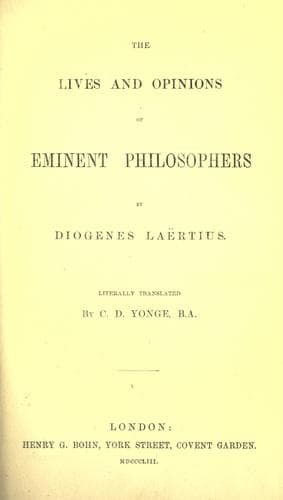
The Lives and Opinions of Eminent PhilosophersDiogenes Laertius
Philosophy
The Lives and Opinions of Eminent Philosophers
Diogenes Laertius
Philosophers, Ancient -- Biography; Philosophy, Ancient
VII. The following works are attributed to him. Two books of Exhortatory
Discourses; Dialogues on the Doctrines of Zeno; six books of
Conversations; seven books of Discussions on Wisdom; Conversations on
Love; Commentaries on Vain Glory; twenty-five books of Reminiscences;
three books of Memorabilia; eleven books of Apophthegms; a volume
against the Orators; a volume against the Rescripts of Alexinus; three
treatises against the Dialecticians; four books of Letters to Cleanthes.
But Panætius and Sosicrates say, that his only genuine writings are his
letters; and that all the rest are the works of Ariston the Peripatetic.
VIII. It is said that he, being bald, got a stroke of the sun, and so
died. And we have written a jesting epigram on him in Scazon iambics, in
the following terms:—
Why, O Ariston, being old and bald,
Did you allow the sun to roast your crown?
Thus, in an unbecoming search for warmth,
Against your will, you’ve found out chilly Hell.
IX. There was also another man of the name of Ariston; a native of Julii,
one of the Peripatetic school. And another who was an Athenian musician.
A fourth who was a tragic poet. A fifth, a native of Alæa, who wrote a
treatise on the Oratorical Art. A sixth was a peripatetic Philosopher of
Alexandria.
LIFE OF HERILLUS
I. Herillus, a native of Carthage, said that the chief good was
knowledge; that is to say, the always conducting one’s self in such a way
as to refer everything to the principle of living according to knowledge,
and not been misled by ignorance. He also said that knowledge was a habit
not departing from reason in the reception of perceptions.
On one occasion, he said that there was no such thing as a chief good,
but that circumstances and events changed it, just as the same piece of
brass might become a statue either of Alexander or of Socrates. And that
besides the chief good or end (τέλος[95]), there was a subordinate end
(ὑποτελίς) different from it. And that those who were not wise aimed at
the latter; but that only the wise man directed his views to the former.
And all the things between virtue and vice he pronounced indifferent.
II. His books contain but few lines, but they are full of power, and
contain arguments in opposition to Zeno.
III. It is said, that when he was a boy, many people were attached to
him; and as Zeno wished to drive them away, he persuaded him to have his
head shaved, which disgusted them all.
IV. His books are these. One on Exercise; one on the Passions; one on
Opinion; the Lawgiver; the Skilful Midwife; the Contradictory Teacher;
the Preparer; the Director; the Mercury; the Medea; a book of Dialogues;
a book of Ethical Propositions.
LIFE OF DIONYSIUS
I. Dionysius, the Deserter, as he was called, asserted that pleasure
was the chief good, from the circumstance of his being afflicted with
a complaint in his eyes. For, as he suffered severely, he could not
pronounce pain a thing indifferent.
Public-domain text, read in full here on John Shaqi.
Reviews
Reviews
No reviews yet
Be the first to share your thoughts on this work.
Elsewhere in the archive
Join the Discussion
Join the discussion
Sign in to leave a comment or review.
Sign InorCreate an account