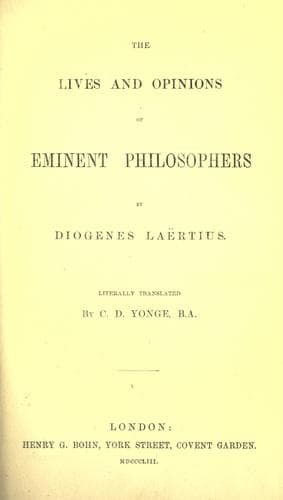
The Lives and Opinions of Eminent PhilosophersDiogenes Laertius
Philosophy
The Lives and Opinions of Eminent Philosophers
Diogenes Laertius
Philosophers, Ancient -- Biography; Philosophy, Ancient
VI. And he left behind him some excellent books, which are these. One
on Time; two on Zeno’s System of Natural Philosophy; four books of the
Explanations of Heraclitus; one on Sensation; one on Art; one addressed
to Democritus; one to Aristarchus; one to Herillus; two on Desire; one
entitled Archæology; one on the Gods; one on the Giants; one on Marriage;
one on Poets; three on Duty; one on Good Counsel; one on Favour; one
called Exhortatory; one on Virtues; one on Natural Ability; one on
Gorgippus; one on Enviousness; one on Love; one on Freedom; one called
the Art of Love; one on Honour; one on Glory; The Statesman; one on
Counsel; one on Laws; one on Deciding as a Judge; one on the Way of Life;
three on Reason; one on the Chief Good; one on the Beautiful; one on
Actions; one on Knowledge; one on Kingly Power; one on Friendship; one on
Banquets; one on the Principle that Virtue is the same in Man and Woman;
one on the Wise Man Employing Sophisms; one on Apophthegms; two books
of Conversations; one on Pleasure; one on Properties; one on Doubtful
Things; one on Dialectics; one on Modes; one on Categorems.
VII. These are his writings.
And he died in the following manner. His gums swelled very much; and,
at the command of his physicians, he abstained from food for two days.
And he got so well that his physicians allowed him to return to all his
former habits; but he refused, and saying that he had now already gone
part of the way, he abstained from food for the future, and so died;
being, as some report, eighty years old, and having been a pupil of Zeno
nineteen years. And we have written a playful epigram on him also, which
runs thus:—
I praise Cleanthes, but praise Pluto more;
Who could not bear to see him grown so old,
So gave him rest at last among the dead,
Who’d drawn such loads of water while alive.
LIFE OF SPHÆRUS.
I. Sphærus, a native of the Bosphorus, was, as we have said before, a
pupil of Cleanthes after the death of Zeno.
II. And when he made a considerable advance in philosophy he went to
Alexandria, to the court of Ptolemy Philopater. And once, when there
was a discussion concerning the question whether a wise man would allow
himself to be guided by opinion, and when Sphærus affirmed that he would
not, the king, wishing to refute him, ordered some pomegranates of wax
to be set before him; and when Sphærus was deceived by them, the king
shouted that he had given his assent to a false perception. But Sphærus
answered very neatly, that he had not given his assent to the fact that
they were pomegranates, but to the fact that it was probable that they
might be pomegranates. And that a perception which could be comprehended
differed from one that was only probable.
Once, when Mnesistratus accused him of denying that Ptolemy was a king,
he said to him, “That Ptolemy was a man with such and such qualities, and
a king.”[101]
Public-domain text, read in full here on John Shaqi.
Reviews
Reviews
No reviews yet
Be the first to share your thoughts on this work.
Elsewhere in the archive
Join the Discussion
Join the discussion
Sign in to leave a comment or review.
Sign InorCreate an account