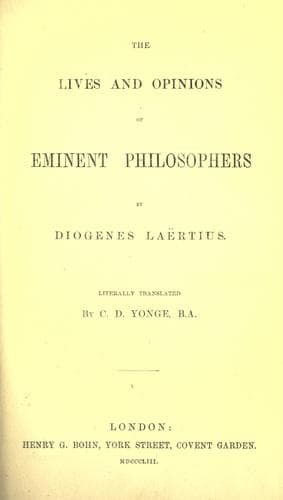
The Lives and Opinions of Eminent PhilosophersDiogenes Laertius
Philosophy
The Lives and Opinions of Eminent Philosophers
Diogenes Laertius
Philosophers, Ancient -- Biography; Philosophy, Ancient
III. He wrote the following books. Two on the World; one on the Elements
of Seed; one on Fortune; one on the Smallest Things; one on Atoms and
Phantoms; one on the Senses; five Conversations about Heraclitus; one on
Ethical Arrangement; one on Duty; one on Appetite; two on the Passions;
one on Kingly Power; on the Lacedæmonian Constitution; three on Lycurgus
and Socrates; one on Law; one on Divination; one volume of Dialogues on
Love; one on the Eretrian Philosophers; one on Things Similar; one on
Terms; one on Habits; three on Contradictions; one on Reason; one on
Riches; one on Glory; one on Death; two on the Art of Dialectics; one on
Categorems; one on Ambiguity; and a volume of Letters.
LIFE OF CHRYSIPPUS.
I. Chrysippus was the son of Apollonius, and a native of either Soli or
Tarsus, as Alexander tells us in his Successions; and he was a pupil of
Cleanthes. Previously he used to practise running as a public runner;
then he became a pupil of Zeno or of Cleanthes, as Diocles and the
generality of authors say, and while he was still living he abandoned
him, and became a very eminent philosopher.
II. He was a man of great natural ability, and of great acuteness in
every way, so that in many points he dissented from Zeno, and also
from Cleanthes, to whom he often used to say that he only wanted to
be instructed in the dogmas of the school, and that he would discover
the demonstrations for himself. But whenever he opposed him with any
vehemence, he always repented, so that he used frequently to say:—
In most respects I am a happy man,
Excepting where Cleanthes is concerned;
For in that matter I am far from fortunate.
And he had such a high reputation as a dialectician, that most people
thought that if there were such a science as dialectics among the Gods;
it would be in no respect different from that of Chrysippus. But though
he was so eminently able in matter, he was not perfect in style.
III. He was industrious beyond all other men; as is plain from his
writings; for he wrote more than seven hundred and five books. And he
often wrote several books on the same subject, wishing to put down
everything that occurred to him; and constantly correcting his previous
assertions, and using a great abundance of testimonies. So that, as in
one of his writings he had quoted very nearly the whole of the Medea of
Euripides, and some one had his book in his hands; this latter, when he
was asked what he had got there, made answer, “The Medea of Chrysippus.”
And Apollodorus, the Athenian, in his Collection of Dogmas, wishing to
assert that what Epicurus had written out of his own head, and without
any quotations to support his arguments, was a great deal more than all
the books of Chrysippus, speaks thus (I give his exact words), “For if
any one were to take away from the books of Chrysippus all the passages
which he quotes from other authors, his paper would be left empty.”
Public-domain text, read in full here on John Shaqi.
Reviews
Reviews
No reviews yet
Be the first to share your thoughts on this work.
Elsewhere in the archive
Join the Discussion
Join the discussion
Sign in to leave a comment or review.
Sign InorCreate an account