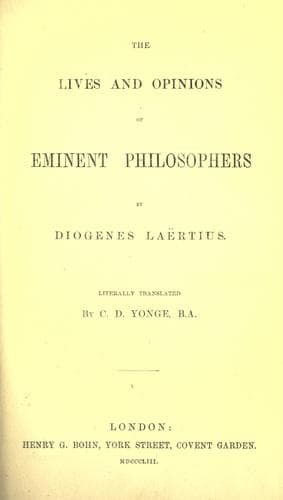
The Lives and Opinions of Eminent PhilosophersDiogenes Laertius
Philosophy
The Lives and Opinions of Eminent Philosophers
Diogenes Laertius
Philosophers, Ancient -- Biography; Philosophy, Ancient
But some people say that he died of a fit of immoderate laughter. For
that seeing his ass eating figs, he told his old woman to give the ass
some unmixed wine to drink afterwards, and then laughed so violently that
he died.
VIII. He appears to have been a man of exceeding arrogance. Accordingly,
though he wrote such numbers of books, he never dedicated one of them
to any sovereign. And he was contented with one single old woman, as
Demetrius tells us, in his People of the same Name. And when Ptolemy
wrote to Cleanthes, begging him either to come to him himself or to send
him some one, Sphærus went to him, but Chrysippus slighted the invitation.
IX. However, he sent for the sons of his sister, Aristocreon and
Philocrates, and educated them; and he was the first person who ventured
to hold a school in the open air in the Lyceum, as the before mentioned
Demetrius relates.
X. There was also another Chrysippus, a native of Cnidos, a physician,
from whom Erasistratus testifies that he received great benefit. And
another also who was a son of his, and the physician of Ptolemy; who,
having had a false accusation brought against him, was apprehended and
punished by being scourged. There was also a fourth who was a pupil of
Erasistratus; and a fifth was an author of a work called Georgics.
XI. Now this philosopher used to delight in proposing questions of this
sort. The person who reveals the mysteries to the uninitiated commits
a sin; the hierophant reveals them to the uninitiated; therefore the
hierophant commits sin? Another was, that which is not in the city, is
also not in the house; but a well is not in the city, therefore, there is
not a well in the house. Another was, there is a certain head; that head
you have not got; there is then a head that you have not got; therefore,
you have not got a head. Again, if a man is in Megara, he is not in
Athens; but there is a man in Megara, therefore, there is not a man in
Athens. Again, if you say anything, what you say comes out of your mouth;
but you say “a waggon,” therefore a waggon comes out of your mouth.
Another was, if you have not lost a thing, you have it; but you have not
lost horns; therefore, you have horns. Though some attribute this sophism
to Eubulides.
Public-domain text, read in full here on John Shaqi.
Reviews
Reviews
No reviews yet
Be the first to share your thoughts on this work.
Elsewhere in the archive
Join the Discussion
Join the discussion
Sign in to leave a comment or review.
Sign InorCreate an account