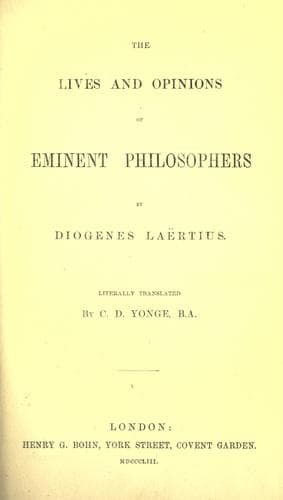
The Lives and Opinions of Eminent PhilosophersDiogenes Laertius
Philosophy
The Lives and Opinions of Eminent Philosophers
Diogenes Laertius
Philosophers, Ancient -- Biography; Philosophy, Ancient
XII. There are people who run Chrysippus down as having written a great
deal that is very shameful and indecent. For in his treatise on the
Ancient Natural Historians, he relates the story of Jupiter and Juno
very indecently, devoting six hundred lines to what no one could repeat
without polluting his mouth. For, as it is said, he composes this story,
though he praises it as consisting of natural details, in a way more
suitable to street walkers than to Goddesses; and not at all resembling
the ideas which have been adopted or cited by writers in paintings. For
they were found neither in Polemo, nor in Hypsicrates, nor in Antigonus,
but were inserted by himself. And in his treatise on Polity, he allows
people to marry their mothers, or their daughters, or their sons. And
he repeats this doctrine in his treatise on those things which are not
desirable for their own sake, in the very opening of it. And in the third
book of his treatise on Justice, he devotes a thousand lines to bidding
people devour even the dead.
In the second book of his treatise on Life and Means of Support, where he
is warning us to consider beforehand, how the wise man ought to provide
himself with means, he says, “And yet why need he provide himself with
means? for if it is for the sake of living, living at all is a matter
of indifference; if it is for the sake of pleasure, that is a matter of
indifference too; if it is for the sake of virtue, that is of itself
sufficient for happiness. But the methods of providing one’s self with
means are ridiculous; for instance, some derive them from a king; and
then it will be necessary to humour him. Some from friendship; and
then friendship will become a thing to be bought with a price. Some
from wisdom; and then wisdom will become mercenary; and these are the
accusations which he brings.”
But since he has written many books of high reputation, it has seemed
good to me to give a catalogue of them, classifying them according to
their subjects. They are the following:—
Books on Logic; Propositions; Logical Questions; a book of the
Contemplations of the Philosopher; six books of Dialectic Terms addressed
to Metrodorus; one on the Technical Terms used in Dialectics, addressed
to Zeno; one called the Art of Dialectics, addressed to Aristagoras; four
books of Probable Conjunctive Reasons, addressed to Dioscorides.
The first set of treatises on the Logical Topics, which concern things,
contains: one essay on Propositions; one on those Propositions which are
not simple; two on the Copulative Propositions, addressed to Athenades;
three on Positive Propositions, addressed to Aristagoras; one on Definite
Propositions, addressed to Athenodorus; one on Privative Propositions,
addressed to Thearus; three on the Best Propositions, addressed to Dion;
four on the Differences between Indefinite Propositions; two on those
Propositions which are enunciated with a reference to time; two on
Perfect Propositions.
Public-domain text, read in full here on John Shaqi.
Reviews
Reviews
No reviews yet
Be the first to share your thoughts on this work.
Elsewhere in the archive
Join the Discussion
Join the discussion
Sign in to leave a comment or review.
Sign InorCreate an account