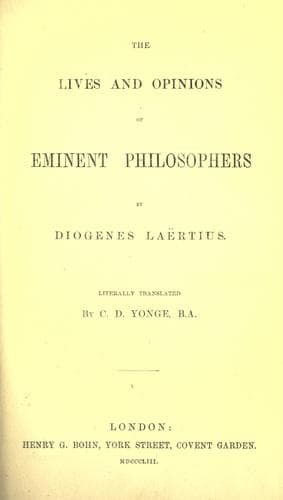
The Lives and Opinions of Eminent PhilosophersDiogenes Laertius
Philosophy
The Lives and Opinions of Eminent Philosophers
Diogenes Laertius
Philosophers, Ancient -- Biography; Philosophy, Ancient
Dear youths, I warn you cherish peace divine,
And in your hearts lay deep these words of mine.
A third about the Soul; a fourth on Piety; a fifth entitled Helothales,
which was the name of the father of Epicharmus, of Cos; a sixth called
Crotona, and other poems too. But the mystic discourse which is extant
under his name, they say is really the work of Hippasus, having been
composed with a view to bring Pythagoras into disrepute. There were
also many other books composed by Aston, of Crotona, and attributed to
Pythagoras.
Aristoxenus asserts that Pythagoras derived the greater part of his
ethical doctrines from Themistoclea, the priestess at Delphi. And Ion,
of Chios, in his Victories, says that he wrote some poems and attributed
them to Orpheus. They also say that the poem called the Scopiadæ is by
him, which begins thus:—
Behave not shamelessly to any one.
VI. And Sosicrates, in his Successions, relates that he, having being
asked by Leon, the tyrant of the Phliasians, who he was, replied, “A
philosopher.” And adds, that he used to compare life to a festival. “And
as some people came to a festival to contend for the prizes, and others
for the purposes of traffic, and the best as spectators; so also in life,
the men of slavish dispositions,” said he, “are born hunters after glory
and covetousness, but philosophers are seekers after truth.” And thus he
spoke on this subject. But in the three treatises above mentioned, the
following principles are laid down by Pythagoras generally.
He forbids men to pray for anything in particular for themselves,
because they do not know what is good for them. He calls drunkenness an
expression identical with ruin, and rejects all superfluity, saying,
“That no one ought to exceed the proper quantity of meat and drink.”
And on the subject of venereal pleasures, he speaks thus:—“One ought
to sacrifice to Venus in the winter, not in the summer; and in autumn
and spring in a lesser degree. But the practice is pernicious at every
season, and is never good for the health.” And once, when he was asked
when a man might indulge in the pleasures of love, he replied, “Whenever
you wish to be weaker than yourself.”
VII. And he divides the life of man thus. A boy for twenty years; a
young man (νεάνισκος) for twenty years; a middle-aged man (νεανίας) for
twenty years; an old man for twenty years. And these different ages
correspond proportionably to the seasons: boyhood answers to spring;
youth to summer; middle age to autumn; and old age to winter. And he uses
νεάνισκος here as equivalent to μειράκιον, and νεανίας as equivalent to
ἀνὴρ.
Public-domain text, read in full here on John Shaqi.
Reviews
Reviews
No reviews yet
Be the first to share your thoughts on this work.
Elsewhere in the archive
Join the Discussion
Join the discussion
Sign in to leave a comment or review.
Sign InorCreate an account