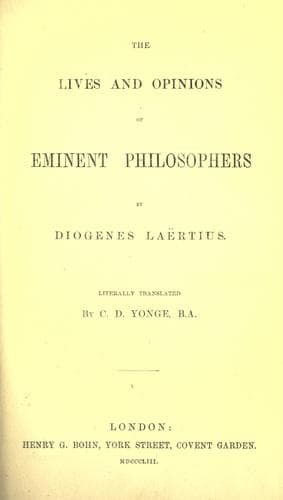
The Lives and Opinions of Eminent PhilosophersDiogenes Laertius
Philosophy
The Lives and Opinions of Eminent Philosophers
Diogenes Laertius
Philosophers, Ancient -- Biography; Philosophy, Ancient
VIII. He was the first person, as Timæus says, who asserted that the
property of friends is common, and that friendship is equality. And his
disciples used to put all their possessions together into one store, and
use them in common; and for five years they kept silence, doing nothing
but listen to discourses, and never once seeing Pythagoras, until they
were approved; after that time they were admitted into his house, and
allowed to see him. They also abstained from the use of cypress coffins,
because the sceptre of Jupiter was made of that wood, as Hermippus tells
us in the second book of his account of Pythagoras.
IX. He is said to have been a man of the most dignified appearance, and
his disciples adopted an opinion respecting him, that he was Apollo
who had come from the Hyperboreans; and it is said, that once when he
was stripped naked, he was seen to have a golden thigh. And there were
many people who affirmed, that when he was crossing the river Nessus it
addressed him by his name.
X. Timæus, in the tenth book of his Histories, tells us, that he used to
say that women who were married to men had the names of the Gods, being
successively called virgins, then nymphs, and subsequently mothers.
XI. It was Pythagoras also who carried geometry to perfection, after
Mœris had first found out the principles of the elements of that
science, as Aristiclides tells us in the second book of his History
of Alexander; and the part of the science to which Pythagoras applied
himself above all others was arithmetic. He also discovered the numerical
relation of sounds on a single string: he also studied medicine.
And Apollodorus, the logician, records of him, that he sacrificed a
hecatomb, when he had discovered that the square of the hypothenuse of a
right-angled triangle is equal to the squares of the sides containing the
right angle. And there is an epigram which is couched in the following
terms:—
When the great Samian sage his noble problem found,
A hundred oxen dyed with their life-blood the ground.
Public-domain text, read in full here on John Shaqi.
Reviews
Reviews
No reviews yet
Be the first to share your thoughts on this work.
Elsewhere in the archive
Join the Discussion
Join the discussion
Sign in to leave a comment or review.
Sign InorCreate an account