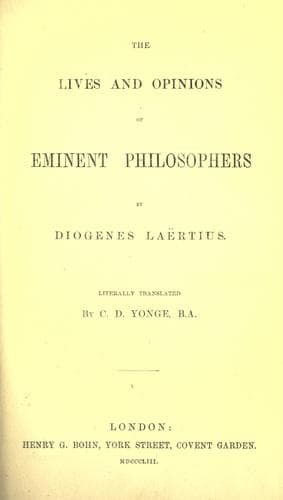
The Lives and Opinions of Eminent PhilosophersDiogenes Laertius
Philosophy
The Lives and Opinions of Eminent Philosophers
Diogenes Laertius
Philosophers, Ancient -- Biography; Philosophy, Ancient
And that he used to forbid them to offer victims to the Gods, ordering
them to worship only at those altars which were unstained with blood. He
forbade them also to swear by the Gods; saying, “That every man ought
so to exercise himself, as to be worthy of belief without an oath.” He
also taught men that it behoved them to honour their elders, thinking
that which was precedent in point of time more honourable; just as in the
world, the rising of the sun was more so than the setting; in life, the
beginning more so than the end; and in animals, production more so than
destruction.
Another of his rules was that men should honour the Gods above the
dæmones, heroes above men; and of all men parents were entitled to the
highest degree of reverence. Another, that people should associate with
one another in such a way as not to make their friends enemies, but to
render their enemies friends. Another was that they should think nothing
exclusively their own. Another was to assist the law, and to make
war upon lawlessness. Not to destroy or injure a cultivated tree, nor
any animal either which does not injure men. That modesty and decorum
consisted in never yielding to laughter, and yet not looking stern.
He taught that men should avoid too much flesh, that they should in
travelling let rest and exertion alternate; that they should exercise
memory; that they should never say or do anything in anger; that they
should not pay respect to every kind of divination; that they should
use songs set to the lyre; and by hymns to the Gods and to eminent men,
display a reasonable gratitude to them.
He also forbade his disciples to eat beans, because, as they were
flatulent, they greatly partook of animal properties [he also said that
men kept their stomachs in better order by avoiding them]; and that such
abstinence made the visions which appear in one’s sleep gentle and free
from agitation. Alexander also says, in his Successions of Philosophers,
that he found the following dogmas also set down in the Commentaries of
Pythagoras:—
That the monad was the beginning of everything. From the monad proceeds
an indefinite duad, which is subordinate to the monad as to its cause.
That from the monad and the indefinite duad proceed numbers. And from
numbers signs. And from these last, lines of which plane figures consist.
And from plane figures are derived solid bodies. And from solid bodies
sensible bodies, of which last there are four elements; fire, water,
earth, and air. And that the world, which is endued with life, and
intellect, and which is of a spherical figure, having the earth, which
is also spherical, and inhabited all over in its centre, results from a
combination of these elements, and derives its motion from them; and also
that there are antipodes,[112] and that what is below, as respects us, is
above in respect of them.
Public-domain text, read in full here on John Shaqi.
Reviews
Reviews
No reviews yet
Be the first to share your thoughts on this work.
Elsewhere in the archive
Join the Discussion
Join the discussion
Sign in to leave a comment or review.
Sign InorCreate an account