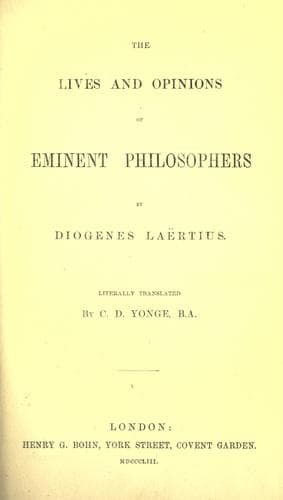
The Lives and Opinions of Eminent PhilosophersDiogenes Laertius
Philosophy
The Lives and Opinions of Eminent Philosophers
Diogenes Laertius
Philosophers, Ancient -- Biography; Philosophy, Ancient
He also taught that light and darkness and cold and heat, and dryness and
moisture, were equally divided in the world; and that, while heat was
predominant it was summer; while cold had the mastery it was winter; when
dryness prevailed it was spring; and when moisture preponderated, winter.
And while all these qualities were on a level, then was the loveliest
season of the year; of which the flourishing spring was the wholesome
period, and the season of autumn the most pernicious one. Of the day, he
said that the flourishing period was the morning, and the fading one the
evening; on which account that also was the least healthy time.
Another of his theories was, that the air around the earth was
immoveable, and pregnant with disease, and that everything in it was
mortal; but that the upper air was in perpetual motion, and pure and
salubrious; and that everything in that was immortal, and on that account
divine. And that the sun, and the moon, and the stars, were all Gods;
for in them the warm principle predominates which is the cause of life.
And that the moon derives its light from the sun. And that there is a
relationship between men and the Gods, because men partake of the divine
principle; on which account also, God exercises his providence for our
advantage. Also, that fate is the cause of the arrangement of the world
both generally and particularly. Moreover, that a ray from the sun
penetrated both the cold æther and the dense æther; and they call the air
(ἀὴρ), the cold æther (ψυχρὸν αἰθέρα), and the sea and moisture they call
the dense æther (παχὺν αἰθέρα). And this ray descends into the depths,
and in this way vivifies everything. And everything which partakes of
the principle of heat lives, on which account also plants are animated
beings; but that all living things have not necessarily souls. And that
the soul is a something torn off from the æther, both warm and cold, from
its partaking of the cold æther. And that the soul is something different
from life. Also, that it is immortal, because that from which it has been
detached is immortal.
Also, that animals are born from one another by seeds, and that it is
impossible for there to be any spontaneous production by the earth.
And that seed is a drop from the brain which contains in itself a warm
vapour; and that when this is applied to the womb, it transmits virtue,
and moisture, and blood from the brain, from which flesh, and sinews, and
bones, and hair, and the whole body are produced. And from the vapour is
produced the soul, and also sensation. And that the infant first becomes
a solid body at the end of forty days; but, according to the principles
of harmony, it is not perfect till seven, or perhaps nine, or at most ten
months, and then it is brought forth. And that it contains in itself all
the principles of life, which are all connected together, and by their
union and combination form a harmonious whole, each of them developing
itself at the appointed time.
Public-domain text, read in full here on John Shaqi.
Reviews
Reviews
No reviews yet
Be the first to share your thoughts on this work.
Elsewhere in the archive
Join the Discussion
Join the discussion
Sign in to leave a comment or review.
Sign InorCreate an account