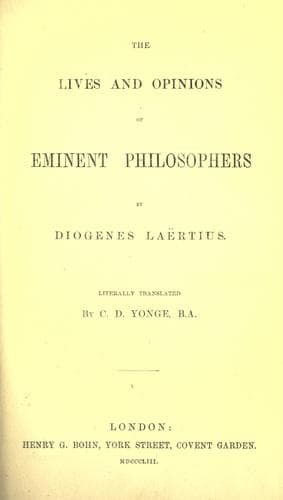
The Lives and Opinions of Eminent PhilosophersDiogenes Laertius
Philosophy
The Lives and Opinions of Eminent Philosophers
Diogenes Laertius
Philosophers, Ancient -- Biography; Philosophy, Ancient
XIX. He was the first author who wrote treatises in the form of
dialogues, as Phavorinus tells us in the eighth book of his Universal
History. And he was also the first person who introduced the analytical
method of investigation, which he taught to Leodamus of Thasos. He
was also the first person in philosophy who spoke of antipodes, and
elements, and dialectics, and actions (ποιήματα), and oblong numbers,
and plane surfaces, and the providence of God. He was likewise the first
of the philosophers who contradicted the assertion of Lysias, the son
of Cephalus, setting it out word for word in his Phædrus. And he was
also the first person who examined the subject of grammatical knowledge
scientifically. And as he argued against almost every one who had lived
before his time, it is often asked why he has never mentioned Democritus.
XX. Neanthes of Cyzicus says, that when he came to the Olympic games
all the Greeks who were present turned to look at him: and that it was
on that occasion that he held a conversation with Dion, who was on
the point of attacking Dionysius. Moreover, in the first book of the
Commentaries of Phavorinus, it is related that Mithridates, the Persian,
erected a statue of Plato in the Academy, and put on it this inscription,
“Mithridates, the son of Rhodobates, a Persian, consecrated an image of
Plato to the Muses, which was made by Silanion.”
XXI. And Heraclides says, that even while a young man, he was so modest
and well regulated, that he was never once seen to laugh excessively.
XXII. But though he was of such a grave character himself, he was
nevertheless ridiculed by the comic poets. Accordingly, Theopompus, in
his Pleasure-seeker, says:—
For one thing is no longer only one,
But two things now are scarcely one; as says
The solemn Plato.
And Anaxandrides in his Theseus, says:—
When he ate olives like our worthy Plato.
And Timon speaks of him in this way, punning on his name:—
As Plato placed strange platitudes on paper.[32]
Alexis says in his Meropis:—
You’ve come in time: since I’ve been doubting long,
And walking up and down some time, like Plato;
And yet have hit upon no crafty plan,
But only tir’d my legs.
And in his Ancylion, he says:—
You speak of what you do not understand,
Running about like Plato: hoping thus,
To learn the nature of saltpetre and onions.
Amphis says in his Amphicrates:—
_A._ But what the good is, which you hope to get
By means of her, my master, I no more
Can form a notion of, than of the good
Of Plato.
_B._ Listen now.
And in his Dexidemides he speaks thus:—
O Plato! how your learning is confined
To gloomy looks, and wrinkling up your brows,
Like any cockle.
Cratinas in his Pseudypobolimæus, says:—
You clearly are a man, endued with sense,
And so, as Plato says, I do not know;
But I suspect.
Alexis, in his Olympiodorus speaks thus:—
Public-domain text, read in full here on John Shaqi.
Reviews
Reviews
No reviews yet
Be the first to share your thoughts on this work.
Elsewhere in the archive
Join the Discussion
Join the discussion
Sign in to leave a comment or review.
Sign InorCreate an account