Animal industry -- United States; Packing-house products
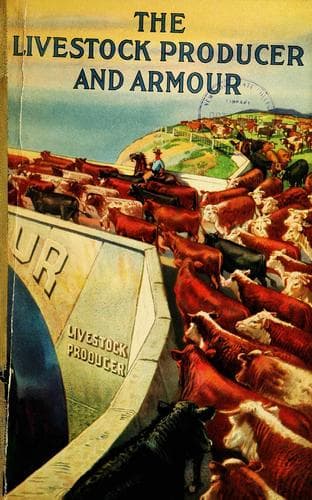
THE LIVESTOCK
PRODUCER AND
ARMOUR
[Illustration]
_The success of capital lies in ministering to the
people, not in taking advantage of them_
Philip D. Armour
1920
ARMOUR AND COMPANY
CHICAGO
[Illustration: _Directors of Armour and Company_
George B. Robbins
C. H. MacDowell
Everett Wilson
Arthur Meeker
Frank W. Waddell
Charles W. Armour
Laurance H. Armour
J. Ogden Armour
A. Watson Armour
Philip D. Armour
F. Edson White
E. A. Valentine
Frederick W. Croll
Robert J. Dunham]
Foreword
THE year 1919, included as it was in the period between the signing of
the Armistice and the ratification of peace, was logically a season
of uncertainty, unrest and unsettled conditions. And yet American
business, discounting all this, entered upon and passed through this
period with full faith in a favorable outcome.
While prosperity was general, the processes of realignment of our
economic relations hurt or temporarily hampered some lines of business.
The livestock and packing industries did not escape entirely unharmed.
Naturally, proposed radical legislation, with accompanying agitation,
and a slump in American meat exports, caused such violent disturbance
of the livestock markets during the latter half of the year that both
producers and packers became deeply concerned as to the immediate
future of the industry.
No array of proved facts as to the low percentage of packer profits,
no pointing out of the real factors controlling meat and livestock
prices was sufficient to convince the disturbed element of the public
and certain agents of the Government that packers’ operations on the
existing large scale were justifiable.
Therefore, by a recent understanding with the Government, Armour and
Company will dispose of all their interests in food production, not
directly associated with and dependent upon the meat packing business.
In addition, Armour and other packers agree to relinquish interests
in stock yards and railway terminal properties at the various market
centers. The terms of the understanding permit the retention of dairy
and poultry products in view of the dependence of these on such
refrigerating and distributive facilities as the packers have provided.
Both patriotism and enlightened self-interest command every citizen
and business to make concessions and sacrifices in times of crises,
whether of war or peace; and while Armour and Company felt that they
were clearly within their rights in their operations previous to this
understanding with the Government, it was plainly in the line of public
service to make concessions that would clear the way towards public
confidence in the development of the livestock industry.
J. Ogden Armour
[Illustration: Running against a “glutted market” in the “good old
days.” Today the stockman’s market is nation-wide.]
How and Why Livestock Market Grew
Public-domain text, read in full here on John Shaqi.
Reviews
Reviews
No reviews yet
Be the first to share your thoughts on this work.
Join the Discussion
Join the discussion
Sign in to leave a comment or review.
Sign InorCreate an account