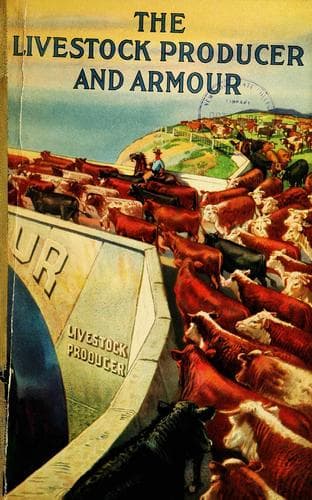
Animal industry -- United States; Packing-house products
This is to the interest of the feeder and the cattle industry as a
whole. For if the business is ever to be placed on a cost-of-production
basis for the reckoning of market prices, it must be done by an
accumulation of thousands of actual tests in feeding practice. It
is plain that each individual feeder could not set or ask a certain
percentage of profit, since a poor judge of stock and a careless feeder
would demand more for an inferior product than the more efficient
feeder would ask for a better article.
The feasibility of any such scheme of regulating prices does not now
appear, but it is clear in any case that each lot of cattle would have
to be appraised at what their production _ought_ to cost, considering
quality, and not what it actually _did_ cost.
[Illustration: Bankers now recognize cattle loans as good investments,
and the skilled stockman has access to needed funds.]
Losses on Declining Markets
THAT the packing industry suffers with the livestock producers on a
falling market was never more clearly emphasized than in the year
1919. Armour and Company’s losses on dressed beef alone amounted, in
the twelve months, to several million dollars; and on the sale of pork
products the losses were even greater.
These losses are figured on the basis of the primary sales, which
include not only the meat but the hides and all other by-products
derived from the animals.
Such deficits do not mean that the Armour organization, as a whole,
suffered a net loss for the year. But there is no mystery about the
methods of countering these deficits. They are offset by the profit
made in manufacturing by-products into merchantable commodities.
Each by-product industry in the Armour organization is placed on its
own responsibility. It must pay to the beef, hog, or sheep killing
department the market value for its raw materials—the same price it
would pay if it purchased on the outside market.
For example, the beef department buys its cattle to the best possible
advantage in competition with other buyers, and sells the beef at the
best price obtainable. The hides go to the tannery at prices ruling on
the open market. If the Armour tannery cannot pay this price the hides
go to outside buyers. To sell at less would be favoring the tannery at
the expense of the beef department, or robbing Peter to pay Paul.
The same business methods are pursued with every scrap of the animal,
whether used in making glue, soap, sand-paper, drugs, fertilizers, or
any other commodity.
While on this basis Armour and Company sustained heavy losses in their
meat departments, the by-product industries showed profits, as they
usually do, because their products are not so perishable and are not so
much influenced by market fluctuations.
Public-domain text, read in full here on John Shaqi.
Reviews
Reviews
No reviews yet
Be the first to share your thoughts on this work.
Join the Discussion
Join the discussion
Sign in to leave a comment or review.
Sign InorCreate an account