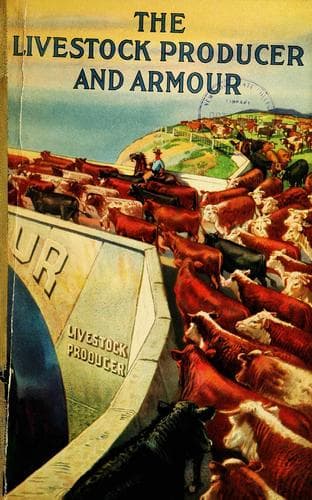
Animal industry -- United States; Packing-house products
Added to these principal factors, and aggravating them, were attempted
boycotts of meat and proposed radical legislation for the regulation
and restriction of the packing industry, and the resulting condition
of uncertainty up to the very closing weeks of 1919, when the
understanding between the packers and the U. S. Department of Justice
was made public.
The big question is, What of the year 1920? While nothing positive can
be predicted, better conditions is a practical certainty. The domestic
consumption of beef is increasing to a gratifying degree; the arranging
of international credits and the opening of foreign markets is a matter
of comparatively short time. European need for pork products will be
urgent and excessive for a considerable time, and this will not only
take care of our surplus hogs, but will react favorably upon the market
for cattle and sheep.
Standard Breeds _of_ Beef Cattle
ABERDEEN-ANGUS
Early maturing; transmits polled character; high dressing percentage;
high proportion valuable cuts.
[Illustration: Aberdeen-Angus]
SHORTHORN
Greatest weight for age; dress out well at slaughter; quiet
disposition; strong milking tendencies.
[Illustration: Shorthorn]
GALLOWAY
Prepotent; adapted to rugged regions; high carcass value; valuable hide.
[Illustration: Galloway]
POLLED SHORTHORN
Characteristics similar to Shorthorn except polled; some strains dual
purpose.
[Illustration: Polled Shorthorn]
HEREFORD
Best grazing breed; matures early; fattens rapidly; good weight for age.
[Illustration: Hereford]
RED POLLED
Strictly dual purpose; fair grazers; early maturing.
[Illustration: Red Polled]
The Livestock Situation
RIGHT now is a good time to stick to the middle of the highway of
common sense. As shown in earlier chapters, the conditions adverse
to the business can be only temporary, and even the losses incurred
may be turned to profit in the end, if the livestock men shall learn
the lesson of economy and efficiency of production and more complete
co-operation among themselves and with the packing industry.
Recent experiences will impel some producers to curtail or discontinue
their operations temporarily, but others will take their places and
quantity of production will be maintained while quality will be
increased.
High-priced land, grain and labor will compel stockmen to grade up
their herds, to discriminate more closely in the purchase of feeding
stock, to improve feeding methods and to keep exact records of costs.
For at the higher level of costs and values all around, as compared
with prewar times, both the risks and rewards of the business will be
greater.
Public-domain text, read in full here on John Shaqi.
Reviews
Reviews
No reviews yet
Be the first to share your thoughts on this work.
Join the Discussion
Join the discussion
Sign in to leave a comment or review.
Sign InorCreate an account