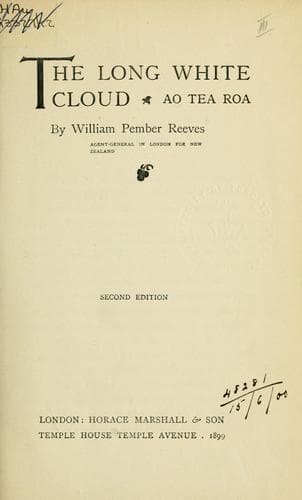
The Long White Cloud: "Ao Tea Roa"Reeves, William Pember
History
The Long White Cloud: "Ao Tea Roa"
Reeves, William Pember
Ethnology -- New Zealand; New Zealand
Governor Fitzroy began at his first _levee_ at Wellington by scolding
the settlers, inveighing against the local newspaper, and grossly
insulting Gibbon Wakefield's son when he was presented to him. At
Nelson he rated the magistrates after such a fashion that they threw
up their commissions. He then went to Rauparaha's _pa_ at Waikanae
near Kapiti. A dozen whites were with the Governor; five hundred
Maoris surrounded the chief. After lecturing the latter for the
slaughter of the captives at Wairau, Fitzroy informed him that, as the
slain men had been the aggressors, he was to be freely forgiven. Only
one utterly ignorant of the Maori character could have fancied that
this exaggerated clemency would be put down to anything but weakness.
Even some missionaries thought that compensation should have been
demanded for the death of the prisoners. As for the settlers, their
disgust was deep. Putting together the haste, violence, and want of
dignity of his proceedings, they declared the new Governor could not
be master of his own actions. That Gibbon Wakefield's brother should
have been savagely butchered and not avenged was bad enough; that his
fellow-settlers should be rated for their share in the disaster seemed
a thing not to be endured. The Maoris grew insolent, the settlers
sullen, and for years afterward a kind of petty warfare lingered on in
the Wellington district.
Governor Fitzroy was no more successful in Taranaki. There the
Company, after claiming the entire territory, had had their claim cut
down by the Commissioners' award to 60,000 acres. But even this was
now disputed, on the ground that it had been bought from a tribe--the
Waikato--who had indeed conquered it, and carried away its owners as
slaves, but had never taken possession of the soil by occupation. When
Colonel Wakefield bought it, the land was virtually empty, and the few
score of natives living at the Sugar-Loaves sold their interest to him
readily enough. But when the enslaved Ngatiawa and Taranaki tribesmen
were soon afterwards released through the influence of Christianity,
they returned to the desolated land, and disputed the claim of the
Company. Moreover, there were the Ngatiawas, who, led by Wiremu Kingi,
had migrated to Cook's Straits in the days of devastation. They
claimed not only their new possessions--much of which they sold to the
Company--but their old tribal lands at Waitara, from which they had
fled, but to which some of them now straggled back. On this nice point
Captain Fitzroy had to adjudicate. He decided that the returned slaves
and Ngatiawa fugitives were the true owners of the land. Instead
of paying them fairly for the 60,000 acres--which they did not
require--he handed the bulk of it back to them, penning the unhappy
white settlers up in a miserable strip of 3,200 acres. The result was
the temporary ruin of the Taranaki settlement, and the sowing of the
seeds of an intense feeling of resentment and injustice which bore
evil fruit in later days.
Public-domain text, read in full here on John Shaqi.
Reviews
Reviews
No reviews yet
Be the first to share your thoughts on this work.
Elsewhere in the archive
Join the Discussion
Join the discussion
Sign in to leave a comment or review.
Sign InorCreate an account