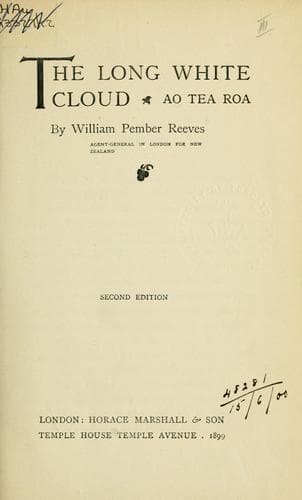
The Long White Cloud: "Ao Tea Roa"Reeves, William Pember
History
The Long White Cloud: "Ao Tea Roa"
Reeves, William Pember
Ethnology -- New Zealand; New Zealand
Nor did Captain Fitzroy do any better with finance than in his land
transactions. His very insufficient revenue was largely derived from
Customs duties. Trade at the Bay of Islands had, by this time, greatly
fallen away. Whalers and timber vessels no longer resorted there as in
the good old Alsatian days. Both natives and settlers grumbled at
the change, which they chose to attribute to the Government Customs
duties. To conciliate them, the Governor abolished Customs duties at
Kororáreka. Naturally a cry at once went up from other parts of the
Colony for a similar concession. The unhappy Governor, endeavouring
to please them all, like the donkey-owner in Æsop's Fables, abolished
Customs duties everywhere. To replace them he devised an astounding
combination of an income-tax and property-tax. Under this, not only
would the rich plainly pay less in proportion than the poor, but a
Government official drawing £600 a year, but owning no land, would pay
just half the sum exacted from a settler who, having invested £1,000
in a farm, was struggling to make £200 a year thereby. The mere
prospect of this crudity caused such a feeling in the Colony that he
was obliged to levy the Customs duties once more. His next error was
the abandonment of the Government monopoly of land purchase from the
Maoris. As might be expected, the pressure upon all rulers in New
Zealand to do this, and to allow private bargaining with the natives
for land, has always been very strong, especially in the Auckland
district. Repeated experience has, however, shown that the results are
baneful to all concerned--demoralizing to the natives, and by no means
always profitable to the white negotiators. When Fitzroy proclaimed
that settlers might purchase land from the natives, he imposed a duty
of ten shillings an acre upon each sale. Then, when this was bitterly
complained of, he reduced the fee to one penny. Finally, he fell back
on the desperate expedient of issuing paper money, a thing which he
had no right to do. All these mistakes and others he managed to commit
within two short years. Fortunately for the Colony, he, in some of
them, flatly disregarded his instructions. The issue of paper money
was one of the few blunders the full force of which Downing Street
could apprehend. Hence his providential recall.
Public-domain text, read in full here on John Shaqi.
Reviews
Reviews
No reviews yet
Be the first to share your thoughts on this work.
Elsewhere in the archive
Join the Discussion
Join the discussion
Sign in to leave a comment or review.
Sign InorCreate an account