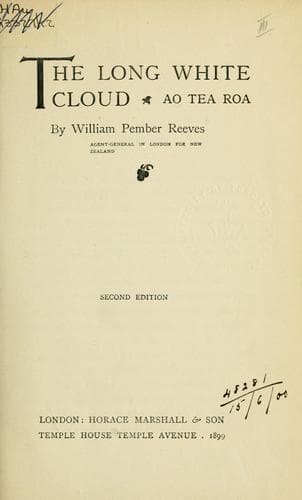
The Long White Cloud: "Ao Tea Roa"Reeves, William Pember
History
The Long White Cloud: "Ao Tea Roa"
Reeves, William Pember
Ethnology -- New Zealand; New Zealand
Before this reached him he had drifted into the last and worst of his
misfortunes, an unsuccessful war, the direct result of the defeat at
the Wairau and the weakness shown thereafter. It was not that he and
his missionary advisers did not try hard enough to avert any conflict
with the Maoris. If conciliation pushed to the verge of submission
could have kept the peace, it would have been kept. But conciliation,
without firmness, will not impress barbarians. The Maoris were far too
acute to be impressed by the well-meaning, vacillating Governor. They
set to work, instead, to impress him. They invited him to a huge
banquet near Auckland, and danced a war-dance before their guest with
the deliberate intention of overawing him. Indeed, the spectacle of
fifteen hundred warriors, stripped, smeared with red ochre, stamping,
swaying, leaping, uttering deep guttural shouts, and brandishing their
muskets, while their wild rhythmic songs rose up in perfect time, and
their tattooed features worked convulsively, was calculated to affect
even stronger nerves than the Governor's.
It was among the discontented tribes in the Bay of Islands, where
Alsatia was now deserted by its roaring crews of whalers and cheated
of its hoped-for capital, that the outbreak came.
In the winter of 1844, Honé Heké, son-in-law of the great Hongi,
presuming on the weakness of the Government, swaggered into
Kororáreka, plundered some of the houses, and cut down a flagstaff
on the hill over the town on which the English flag was flying. Some
White of the beach-comber species is said to have suggested the act
to him by assuring him that the flag-staff represented the Queen's
sovereignty--the evil influence which had drawn trade and money away
to Auckland. Heké had no grievance whatever against the Government or
colonists, but he and the younger braves of the Northern tribes
had been heard to ask whether Rangihaeata was to do all the
_Pakeha_-killing? At the moment Fitzroy had not two hundred soldiers
in the country. He hurried up to the scene of disturbance. Luckily
Heké's tribe--the Ngapuhi--were divided. Part, under Waka Nené, held
with the English. Accepting Nené's advice Fitzroy allowed Heké to pay
ten muskets in compensation for the flagstaff, and then foolishly gave
back the fine as a present and departed. Nené and the friendly chiefs
undertook to keep peace--but failed, for Heké again cut down the
flagstaff. This, of course, brought war definitely on. The famous
flagstaff was re-erected, guarded by a block-house, and a party of
soldiers and sailors were sent to garrison Kororáreka. As H.M.S.
_Hazard_ lay off the beach in the Bay and guns were mounted in three
block-houses, the place was expected to hold out. Heké, however,
notified that he would take it--and did so. He marched against it with
eight hundred men. One party attacked the flagstaff, another the town.
The twenty defenders of the flag-staff were divided by a stratagem by
Public-domain text, read in full here on John Shaqi.
Reviews
Reviews
No reviews yet
Be the first to share your thoughts on this work.
Elsewhere in the archive
Join the Discussion
Join the discussion
Sign in to leave a comment or review.
Sign InorCreate an account