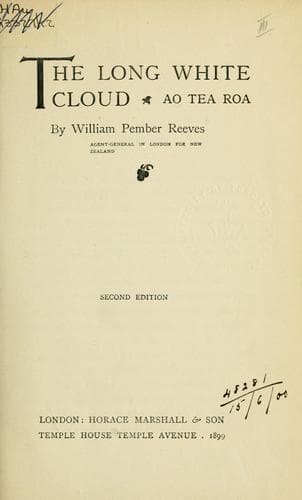
The Long White Cloud: "Ao Tea Roa"Reeves, William Pember
History
The Long White Cloud: "Ao Tea Roa"
Reeves, William Pember
Ethnology -- New Zealand; New Zealand
The petty warfare against Rangihaeata in the Cook's Straits district
took longer to end. It was a series of isolated murders, trifling
skirmishes, night surprises, marchings and counter-marchings. Their
dreary insignificance was redeemed by the good-tempered pertinacity
shown by our troops in enduring month after month of hardship and
exposure in the rain-soaked bush and the deep mud of the sloughs,
miscalled tracks, along which they had to crawl through the gloomy
valleys. And there was one story of heroism. An out-post of the
fifty-eighth regiment had been surprised at dawn. The bugler, a lad
named Allen, was raising his bugle to sound the alarm, when a blow
from a tomahawk half severed his arm. Snatching the bugle with the
other hand, he managed to blow a warning note before a second tomahawk
stroke stretched him dead. Grey adopted the Fabian plan of driving the
insurgents back into the mountain forests and slowly starving them out
there. In New Zealand, thanks to the scarcity of wild food plants and
animals, even Maoris suffer cruel hardships if cut off long from their
plantations.
Rauparaha, now a very old man, was nominally not concerned in these
troubles. He lived quietly in a sea-coast village by the Straits,
enjoying the reputation earned by nearly fifty years of fighting,
massacring and plotting. The Governor, however, satisfied himself that
the old chief was secretly instigating the insurgents. By a cleverly
managed surprise he captured Rauparaha in his village, whence he was
carried kicking and biting on board a man-of-war. The move proved
successful. The _mana_ of the Maori Ulysses was fatally injured in the
eyes of his race by the humiliation. The chief, who had killed Arthur
Wakefield and laughed under Fitzroy's nose, had met at length a
craftier than himself. Detained at Auckland, or carried about in
Grey's train, he was treated with a studied politeness which prevented
him from being honoured as a martyr. His influence was at an end.
Peace quickly came. It is true that at the end of the year 1846 there
came a small outbreak which caused a tiny hamlet, now the town of
Wanganui, to be attacked and plundered. But the natives, who retired
into the bush, were quietly brought to submission by having their
trade stopped, and in particular their supply of tobacco cut off.
Fourteen years of quiet now followed the two years of disturbance.
During the fighting from the Wairau conflict onwards, our loss
had been one hundred and seven Whites killed and one hundred and
seventy-two wounded. To this must be added several "murders" of
settlers and the losses of our native allies. Small as the total was,
it was larger than the casualties of the insurgents.
Public-domain text, read in full here on John Shaqi.
Reviews
Reviews
No reviews yet
Be the first to share your thoughts on this work.
Elsewhere in the archive
Join the Discussion
Join the discussion
Sign in to leave a comment or review.
Sign InorCreate an account