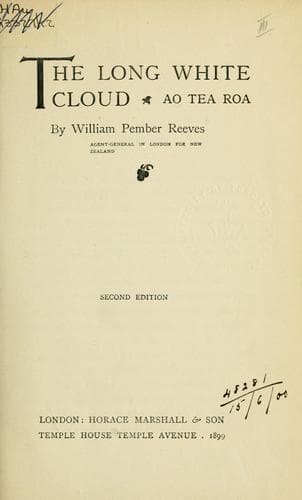
The Long White Cloud: "Ao Tea Roa"Reeves, William Pember
History
The Long White Cloud: "Ao Tea Roa"
Reeves, William Pember
Ethnology -- New Zealand; New Zealand
For his success Governor Grey was made Sir George, and greatly pleased
the natives by choosing Waka Nené and Te Whero Whero, our old Waikato
acquaintance, to act as esquires at his investiture. But it was in
the use he made of the restored tranquillity that he showed his true
capacity. He employed the natives as labourers in making roads, useful
both for war and peace. They found wages better than warfare. As
navvies, they were paid half a crown a day, and were reported to do
more work as spade-men than an equal number of soldiers would. At no
time did the Maoris seem to make such material progress as during the
twelve peaceful years beginning with 1848.
With his brown subjects, Grey, after once beating them, trod the paths
of pleasantness and peace. The chiefs recognised his imperturbable
courage and self-control, and were charmed by his unfailing courtesy
and winning manners. He found time to learn their language. The study
of their character, their myths, customs, and art was not only to him
a labour of love, but bore practical fruit in the knowledge it gave
him of the race. So good were the volumes in which he put together
and published the fruits of his Maori studies, that for nearly half a
century students of Maori literature have been glad to follow in
the way pointed out by this busy administrator. Few men have ever
understood the Natives better. He could humour their childishness and
respect their intelligence. When a powerful chief refused to allow one
of the Governor's roads to be pushed through his tribe's land, Grey
said nothing, but sent the chief's sister a present of a wheeled
carriage. Before long the road was permitted. But on the all-important
question of the validity of the land clause in the treaty of Waitangi,
the Governor always gave the Maoris the fullest assurance. Striving
always to keep liquor and fire-arms from them, he encouraged them to
farm, helped to found schools for them, and interested himself in the
all-important question of their physical health, on which he consulted
and corresponded with Florence Nightingale.
Public-domain text, read in full here on John Shaqi.
Reviews
Reviews
No reviews yet
Be the first to share your thoughts on this work.
Elsewhere in the archive
Join the Discussion
Join the discussion
Sign in to leave a comment or review.
Sign InorCreate an account