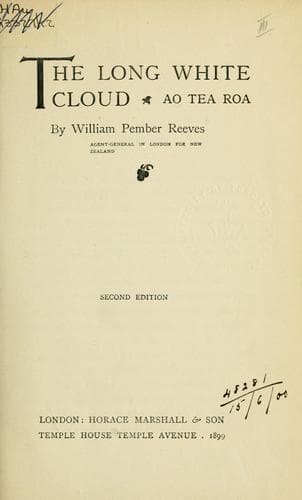
The Long White Cloud: "Ao Tea Roa"Reeves, William Pember
History
The Long White Cloud: "Ao Tea Roa"
Reeves, William Pember
Ethnology -- New Zealand; New Zealand
Among the many interesting figures on the stage of the New Zealand of
the first generation three seem to me to rise head and shoulders above
the crowd--Gibbon Wakefield, Grey, and Selwyn, the founder, the ruler,
the pastor. Nor must it be supposed, because these towered above their
fellow-actors, that the latter were puny men. Plenty of ability found
its way to the Colony, and under the stress of its early troubles wits
were sharpened and faculties brightened. There is nothing like the
colonial grindstone for putting an edge on good steel. Grey, Selwyn,
and Wakefield, as unlike morally as they were in manner, had this in
common, that they were leaders of men, and that they had men to lead.
That for thirty years the representatives of the English Government,
from Busby to Browne, were, with the exception of Grey, commonplace
persons or worse, must not blind us to the interest of the drama or to
the capacity of many of the men whom these commonplace persons were
sent to guide.
Of the trio referred to, Grey is the greatest figure, and most
attractive and complex study. Of such a man destiny might have made a
great visionary, a capable general, an eloquent tribune, or a graceful
writer. He had in him the stuff for any of these. But the south wing
of the British Empire had to be built, and the gods made Grey a social
architect in the guise of a pro-consul. Among the colonies of the
southern hemisphere he is already a figure of history, and amongst
them no man has played so many parts in so many theatres with so much
success. Not merely was he the saviour and organizer of New Zealand,
South Australia, and South Africa; not merely was he an explorer of
the deserts of New Holland, and a successful campaigner in New Zealand
bush-warfare, but he found time, by way of recreation, to be an
ethnologist, a literary pioneer, and an ardent book-collector who
twice was generous enough to found libraries with the books which had
been the solace and happiness of his working life. A mere episode of
this life was the fanning of the spark of Imperialism into flame in
England thirty years ago. There are those who will think the eloquence
with which he led the New Zealand democracy, the results he indirectly
obtained for it, and the stand which at the extreme end of his career
he made with success for a popular basis for the inevitable Australian
Federation, among the least of his feats. To the writer they do not
seem so. Before a life so strenuous, so dramatic, and so fruitful,
criticism--at least colonial criticism--is inclined respectfully to
lay down its pen. But when we come to the man himself, to the mistakes
he made, and the misunderstandings he caused, and to the endeavour to
give some sort of sketch of what he _was_, the task is neither easy
nor always pleasant. I have known those who thought Grey a nobler
Gracchus and a more practical Gordon; and I have known those who
thought him a mean copy of Dryden's Achitophel. His island-retreat,
Public-domain text, read in full here on John Shaqi.
Reviews
Reviews
No reviews yet
Be the first to share your thoughts on this work.
Elsewhere in the archive
Join the Discussion
Join the discussion
Sign in to leave a comment or review.
Sign InorCreate an account