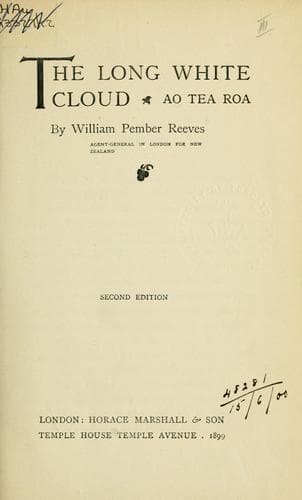
The Long White Cloud: "Ao Tea Roa"Reeves, William Pember
History
The Long White Cloud: "Ao Tea Roa"
Reeves, William Pember
Ethnology -- New Zealand; New Zealand
where Froude described him as a kind of evangelical Cincinnatus,
seemed to others merely the convenient lurking-place of a political
rogue-elephant. The viceroy whose hated household the Adelaide
tradesmen would not deal with in 1844, and the statesman whose visit
to Adelaide in 1891 was a triumphal progress, the public servant whom
the Duke of Buckingham insulted in 1868, and the empire-builder whom
the Queen delighted to honour in 1894, were one and the same man.
So were the Governor against whom New Zealanders inveighed as
an arch-despot in 1848, and the popular leader denounced as
arch-demagogue by some of the same New Zealanders thirty years
afterwards. In a long life of bustle and change his strong but mixed
character changed and moulded circumstances, and circumstances also
changed and moulded him. The ignorant injustice of some of his Downing
Street masters might well have warped his disposition even more than
it did. The many honest and acute men who did not keep step with Grey,
who were disappointed in him, or repelled by and embittered against
him, were not always wrong. Some of his eulogists have been silly. But
the student of his peculiar nature must be an odd analyst who does
not in the end conclude that Grey was on the whole more akin to the
Christian hero painted by Froude and Olive Schreiner than to
the malevolent political chess-player of innumerable colonial
leader-writers.
Grey had the knightly virtues--courage, courtesy, and self-command.
His early possession of official power in remote, difficult,
thinly-peopled outposts gave him self-reliance as well as dignity.
Naturally fond of devious ways and unexpected moves, he learned to
keep his own counsel and to mask his intentions; he never even seemed
frank. Though wilful and quarrelsome, he kept guard over his tongue,
but, pen in hand, became an evasive, obstinate controversialist with
a coldly-used power of exasperation. He learned to work apart, and
practised it so long that he became unable to co-operate, on equal
terms, with any fellow-labourer. He would lead, or would go alone.
Moreover, so far as persons went, his antipathies were stronger than
his affections, and led him to play with principles and allies. Those
who considered themselves his natural friends were never astonished to
find him operating against their flank to the delight of the common
enemy. Fastidiously indifferent to money, he was greedy of credit;
could be generous to inferiors, but not to rivals; could be grateful
to God, but hardly to man.
Public-domain text, read in full here on John Shaqi.
Reviews
Reviews
No reviews yet
Be the first to share your thoughts on this work.
Elsewhere in the archive
Join the Discussion
Join the discussion
Sign in to leave a comment or review.
Sign InorCreate an account