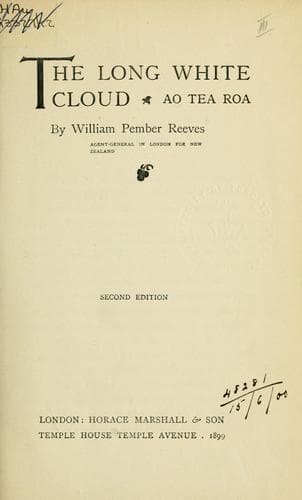
The Long White Cloud: "Ao Tea Roa"Reeves, William Pember
History
The Long White Cloud: "Ao Tea Roa"
Reeves, William Pember
Ethnology -- New Zealand; New Zealand
When he landed in New Zealand, he was a pleasant-looking, blue-eyed,
energetic young officer, with a square jaw, a firm but mobile mouth,
and a queer trick of half closing one eye when he looked at you. For
all his activity he suffered from a spear-wound received from an
Australian blackfellow. He was married to a young and handsome wife;
and, though this was not his first Governorship, was but thirty-three.
The colonists around him were quite shrewd enough to see that this was
no ordinary official, and that beneath the silken surcoat of courtesy
and the plate-armour of self-confidence lay concealed a curious and
interesting man. The less narrow of them detected that something more
was here than a strong administrator, and that they had among them an
original man of action, with something of the aloofness and mystery
that belong to
"a mind for ever
Voyaging through strange seas of thought alone."
None imagined that his connection with the Islands would not terminate
for half a century, and that the good and evil of his work therein
would be such as must be directly felt--to use his own pet phrase--by
unborn millions in distant days.
Chapter XIII
THE PASTORAL PROVINCES
"Whose even thread the Fates spin round and full
Out of their choicest and their whitest wool."
The Company's settlements were no longer confined to the shores of
Cook's Straits. In 1846, Earl Grey, formerly Lord Howick, came to the
Colonial Office, and set himself to compensate the Company for former
official hostility. He secured for it a loan of £250,000, and handed
over to it large blocks of land in the South Island, which--less
certain reserves--was in process of complete purchase from its handful
of Maori owners. The Company, gaining thus a new lease of life, went
to work. In 1848 and 1850 that was done which ought to have been done
a decade sooner, and the void spaces of Otago and Canterbury were
made the sites of settlements of a quasi-religious kind. The Otago
settlement was the outcome of the Scottish Disruption; its pioneers
landed in March, 1848. They were a band of Free Kirk Presbyterians,
appropriately headed by a Captain Cargill, a Peninsular veteran and a
descendant of Donald Cargill, and by the Rev. Thomas Burns, a minister
of sterling worth, who was a nephew of the poet. Otago has this year
celebrated her jubilee, and the mayor of her chief city, Captain
Cargill's son, is the first citizen of a town of nearly 50,000
inhabitants which in energy and beauty is worthy of its name--Dunedin.
For years, however, the progress of the young settlement was slow.
Purchasers of its land at the "sufficient price"--£2 an acre--were
provokingly few, so few indeed that the regulation price had to be
reduced. It had no Maori troubles worth speaking of, but the hills
that beset its site, rugged and bush-covered, were troublesome to
clear and settle, the winter climate is bleaker than that of northern
Public-domain text, read in full here on John Shaqi.
Reviews
Reviews
No reviews yet
Be the first to share your thoughts on this work.
Elsewhere in the archive
Join the Discussion
Join the discussion
Sign in to leave a comment or review.
Sign InorCreate an account